

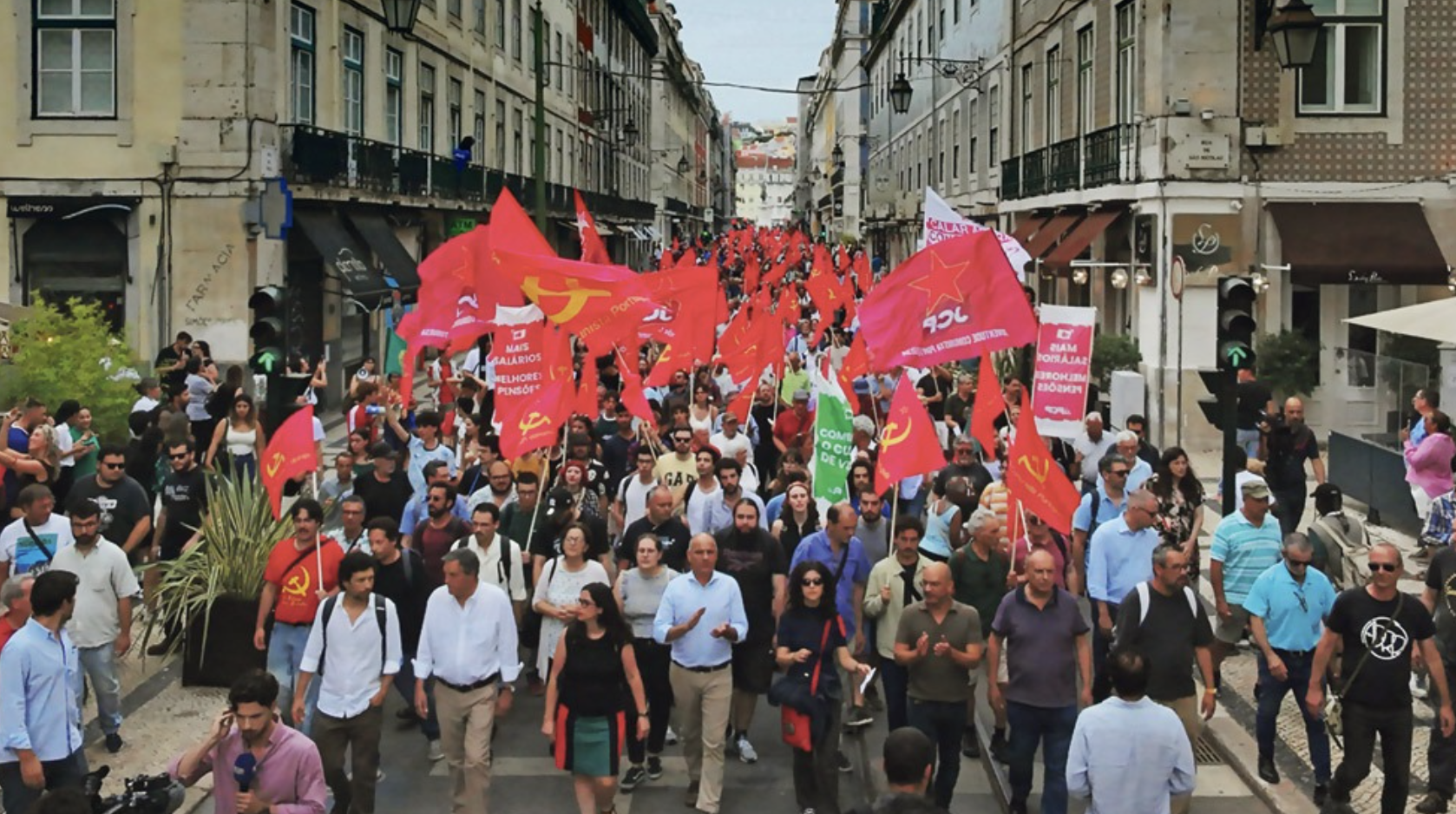
Portugal: Workers’ struggle defeats anti-labor legislation
In a decisive victory for the Portuguese working class, the so-called “Labor Package” proposed by the right-wing PSD/CDS government was defeated in parliament on June 19, after nearly a year of sustained mobilization, including two general strikes. The legislative package — backed by employers’ confederations and initially supported by the far-right Chega party — would have intensified exploitation and eroded trade union rights.
The struggle unfolded over eleven months, marked by two general strikes (December 11 and June 3), major demonstrations on September 20, November 8, January 13, February 28, and April 17, as well as rallies and parliamentary actions. The June 3 general strike saw near-total support at major hospitals and workplaces across the country. Trade unions collected over 190,000 signatures in opposition to the reforms.
The General Confederation of Portuguese Workers (CGTP-IN) played a decisive role in organizing and informing workers. The Portuguese Communist Party (PCP) was actively engaged from the outset, directly reaching thousands of workers to expose the harmful contents of the package.
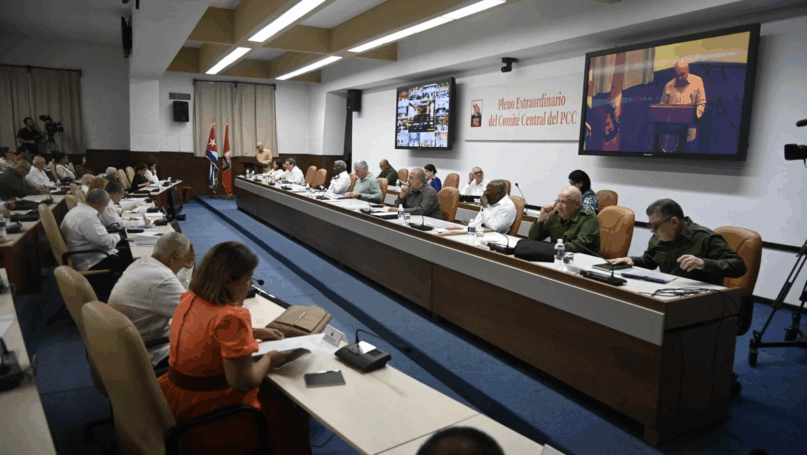
Cuba: Communist Party advances economic reforms amid imperialist siege
The Communist Party of Cuba held a critical Central Committee meeting in June, chaired by First Secretary Miguel Díaz-Canel, to debate and refine a comprehensive package of economic and social transformations. The meeting, which was held under severe threats and hardships caused by the U.S. blockade, nonetheless underscored the party’s commitment to what they called “necessary reforms while maintaining the socialist system.”
Prime Minister Manuel Marrero Cruz presented 176 proposals developed through a consultative process that reviewed 390 suggestions — 66.7% of which were accepted. The reforms focus on “modernizing the economy” while preserving state ownership in strategic sectors and at the same time expanding “economic flexibility.”
Key proposals include:
- Expanding autonomy for state-owned enterprises, including freedom to engage in any legal activity and greater decentralization in pricing decisions. The reforms would eliminate standardized wage scales in the state sector, replacing them with a minimum wage adjusted for inflation and negotiated between employers, workers, and unions.
- Approving pending applications for non-state enterprises, removing the 100-employee limit, allowing individuals to own multiple private companies, and expanding legal business structures. Micro, Small and Medium Enterprises (MSME) would be authorized in agriculture for the first time.
- Creating a national technological hub integrating hardware, software, and artificial intelligence, with competitive salary systems for technology professionals and selective opening of digital infrastructure to foreign investment.
The reforms were framed as consistent with the preservation of socialism, guided by the principle of “doing what is necessary to preserve what is essential.” Raúl Castro emphasized that the best ideas emerge from discussion and even disagreement, calling for broad participation in refining the measures and building consensus for effective implementation.
Iran: Tudeh Party assesses political landscape, calls for democratic alternative
Following the announcement of a framework agreement between Iran and the United States to end the war, the Tudeh Party of Iran issued a comprehensive assessment of the political situation. While welcoming the apparent de-escalation, the party argued that Iran remains in a state of “political limbo” in which neither lasting peace, meaningful reform, nor regime collapse appears imminent.
The Tudeh Party strongly condemned Israeli and U.S. military actions against Iran. It described them as acts of aggression and violations of international law. Particular attention was given to the destruction of water reservoirs in Hormozgan Province, which the party characterized as a war crime. Their statement also sharply criticized President Donald Trump’s threats against Iran and discussions concerning control of Iran’s oil resources and the Strait of Hormuz.
The Tudeh Party argued that the Islamic Republic’s most serious challenge is not foreign pressure but its deepening internal crisis — chronic inflation, currency depreciation, rising poverty, growing social inequality, and widespread economic hardship. The party highlighted the resurgence of labor, pensioners’, student, and social protests, demonstrating the institutionalization of public discontent throughout Iranian society.
The Tudeh Party concluded that neither military conflict nor diplomatic agreements can resolve Iran’s fundamental problems of poverty, unemployment, corruption, discrimination, and lack of democratic freedoms. It called for the creation of a broad, democratic, and inclusive social movement capable of uniting workers, women, students, teachers, retirees, intellectuals, and progressive political forces. The party emphasized that democracy and social justice must be won by the Iranian people themselves through collective organization, struggle, and popular mobilization.
Lebanon: Communist Party rejects Israel-Lebanon agreement
The initial agreement reached between the Lebanese and Israeli governments to end the war was met with anger among the Lebanese resistance, including the Lebanese Communist Party.
The party rejected this agreement which it said, “serves only the Israeli aspirations.” The agreement was brokered by the Trump administation.
“From the outset, we rejected the normalization agreement regarding the demarcation of maritime borders with the Israeli enemy; how, then, could we possibly submit to this agreement of capitulation and surrender now?” asked LCP General Secretary Hanna Gharib. “There is no peace with an entity of apartheid and genocide. Let efforts unite to bring down this shameful agreement.”
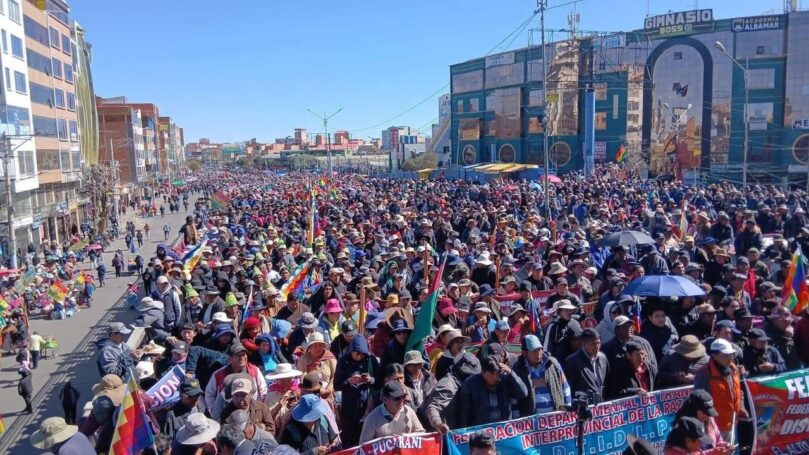
Bolivia: Workers and people rise against Paz government
Bolivia is in the midst of a profound political and social crisis. For over a month, the urban and rural working class carried out sustained protest actions against the government of President Rodrigo Paz. Up to 100 roadblocks have paralyzed the country, choking supplies of food, fuel, and medicine.
According to the Communist Party of Bolivia–RC, “the Paz government — which came to power following the implosion of the MAS governments — has proven itself subservient to foreign monopolies and the agro-industrial bourgeoisie.” Their proposals include eliminating the Tax on Large Fortunes, allowing the return of the DEA, abolishing fuel subsidies, freezing public-sector wages, and enacting Law 1720 to dismantle constitutional protections for small peasant landholdings.
The Bolivian Workers’ Central (COB), peasant and indigenous organizations, and the Federation of Neighborhood Councils (FEJUVE) of El Alto have organized continuous mobilizations, including an indigenous march from Pando that reached La Paz after 28 days on foot and hunger-strike pickets by women. The most recent assembly resolved to demand the resignation of President Paz.
The Paz government’s response has been repression. Paz declared a state of emergency across the country which enabled wider military deployment. The Senate approved a State of Exception bill suspending constitutional guarantees. Police and military operations — accompanied by far-right paramilitary groups such as the Youth Resistance from Cochabamba and the Youth Union from Santa Cruz — left dozens injured. On June 7, five COB leaders were illegally detained and subjected to torture.
The Communist Party of Bolivia (PCB-RC) repudiated the violent repression and expressed solidarity with the COB, CSUTCB, FEJUVE El Alto, and all mobilized organizations. They warn that the Paz government intends to “drench the Bolivian people in blood” to implement its agenda of handing over natural resources to foreign capital and privatizing state enterprises.
Mexico: CNTE teachers wage determined struggle for dignified pensions
The National Coordinator of Education Workers (CNTE) launched an indefinite strike on June 1, with sit-ins in Rosarito, Ensenada, and Tijuana, and the occupation of the Institute of Educational and Pedagogical Services. Striking teachers also blockaded toll booths and the El Chaparral border crossing.
The main demands of the workers are the repeal of the 2007 ISSSTE Law and the 1997 IMSS Law, and the establishment of a new solidarity-based pension and retirement system. The strike impacted more than 400 schools with total stoppages and another 200 with intermittent action.
The Communist Party of Mexico expressed solidarity with the teachers, emphasizing that the struggle against pension privatization is a fight for all workers.
Following dialogue with federal and state authorities, the CNTE lifted its strike on June 20 after securing commitments on local demands and administrative resolutions. However, the struggle to secure a dignified pension system continues.
Ireland and Britain: Communist parties condemn racist violence in Belfast
The Communist Party of Ireland and the Communist Party of Britain condemned the racist violence following a knife attack in Belfast on June 8. The parties said that organized loyalist elements and far-right agitators sought to exploit the incident to spread fear and division, attacking homes, targeting businesses, and intimidating migrant families.
The Communist Party of Ireland rejected any attempt to hold an entire community responsible for the actions of an individual, describing the attacks as “pogroms” that deliberately echo the sectarian violence of the 1960s and 1970s. The party praised trade unionists, community activists, and local residents who mobilized to defend threatened families.
“The far right offers no solutions to the problems facing working people,” the party stated. “It cannot build homes, improve public services, raise wages, or strengthen communities. Its politics are based on division, setting worker against worker while the real causes of social and economic hardship remain untouched.”
The statement emphasized the class character of the situation, linking far-right groups with billionaires and their efforts to divide the working class.

Cyprus: AKEL makes strides in national elections
The Progressive Party of Working People in Cyprus, AKEL, had electoral success in their recent parliamentary elections. The party increased its vote share and retained its seats, which demonstrates the party’s growing influence and commitment to addressing economic pressures and advocating for progressive change.
The party aims to build a broad social majority to bring about change by 2028, focusing on issues like dignified wages, housing, and the Cyprus problem. AKEL said it will intensify its presence in society and continue its efforts towards a bizonal, bicommunal federation.
India: Electoral losses, CPI(M) and CPI fightback
In May, the communist-led governing coalition in Keralam, the Left Democratic Front (LDF), lost state power. The prevailing anti-incumbency sentiment after 10 years in power belies the significant gains in the state, including the eradication of poverty and widescale reforms for local rule, education and health benefits. The LDF still managed 37.6% of the vote, suggesting a future return to governance is likely. The biggest losses were in the formerly progressive state of West Bengal where the bigoted BJP gained control for the first time in the state’s history against the Trinamool Congress’ corrupt long-term rule.
The dedicated resistance by the Indian Communist Parties after these losses was immediate — as was the repression against the CPI and CPI(M). In West Bengal, the CPI(M) and CPI are taking leadership to resist the widescale purging of electoral roles and the violent harassment and eviction of small-scale food vendors in Kolkata. Over 2.7 million people across the state of West Bengal were deprived of the right to vote in the unprecedented deletion of names by the Election Commission of India. Communists have contested this illegal action, awaiting the verdict from the Supreme Court.
Immediately after the elections, the BJP-Hindutva combine beat up and displaced street vendors, who are among the most marginalized people in the city. They also created “holding centers” for undocumented migrants to the state. Communist youth and students have actively fought to protect these small businesses from the assault, facing the BJP-led vigilante violence directly across the city.
Israel: Communist Party prepares list for elections
The Democratic Front for Peace and Equality (Hadash), headed by the Israeli Communist Party (MAKI) is preparing for the upcoming elections in Israel. Under its newly elected head of their election list, Comrade Yousef Jabreen, Hadash is the lone voice calling for joint Arab-Jewish solidarity and unity in fighting against Netenyahu and his fascist, Kahanist allies, Ben-Gvir and Smotrich.
Hadash is also hoping to re-vitalise the Joint List, an electoral bloc that at one point consisted of Hadash and the Palestinian parties, The United Arab List, Balad (The National Democratic Alliance) and Ta’al (the Arab Union). Hadash and its allies believe that running in a united election bloc will empower the Arab electorate, and help weaken the fascist bloc.
Hadash’s message to the voters is that they represent the only legitimate resistance to fascism and that the so called “liberal opposition parties” support the occupation, oppression and disenfranchisement of Palestinians, just like Netenyahu and his allies. Hadash and its allies are the only parties that are calling for full and equal rights for all Arab citizens, an end to the occupation, and the establishment of a Palestinian State.
Further, Hadash and MAKI are continuing its historic message, calling for workers rights, democracy, social justice and peace.
South Africa: Communist party holds ‘Conference of the Left’
Bringing together an assembly of trade unions, grassroots social movements, and left and progressive organizations, the conference organized by the South African Communist Party (SACP) diagnosed South Africa’s current instability as a deep structural crisis fueled by neoliberal policies, austerity, and incomplete post-1994 democratic transformation. Delegates asserted that the immediate task is to safeguard existing democratic achievements while aggressively advancing toward genuine economic democracy, social ownership, and working-class hegemony.
The conference resolved to launch the “Council of the Left” as a permanent coordinating framework. Emphasizing that this body is not a political party and will not contest elections, organizers affirmed that the Council will respect the autonomy of its constituent groups while managing shared campaigns, political education, and mass mobilization.
The initiative will immediately target an eight-cluster Programme of Action addressing core issues such as the cost-of-living crisis, land justice, and ecological sustainability, alongside an internationalist commitment to push for a South African Cuba Solidarity and the Anti-Blockade Bill.
Images: Portuguese Communist Party marches during June 3 general strike. Avante; Communist Party of Cuba holds Plenary Central Committee meeting on economic and social reforms. ICP; Mass uprising in Bolivia against the right-wing Paz government. ICP; AKEL and EDON members rally before parliamentary elections in Cyprus. AKEL.

 Join Now