

The follow is a review of The Vision of the Municipal Left: Peter V. Cacchione and New York City, 1930s–1940s by Kim Phillips-Fein.
At the heart of this version of electoral radicalism was a deep interest in the project of building a mass movement through electoral means. “Never forget we are a party of socialism,” read one 1939 guide to public speaking. “Tell our ultimate aim openly and frankly.” It encouraged speakers to use simple words, avoid stock quotations, and take care not to go on too long. Most of all, they should “look upon the audience as living people” who were deserving of respect.
During his time as an elected official, Peter Cacchione helped to promote working-class causes such as union rights, cheap transit, and rent regulation, and to push against racism, discrimination, and anti-Semitism. He supported the extension of the system of “nurseries” and childcare that the city had adopted to enable women to work during the war years into the postwar period. And he regularly promoted electoral politics and deepening civic engagement in the public life of the city.
Phillips-Fein’s full article will be published in the following collection in August. In the excerpts, she tries to connect them. However, there are many CPUSA works and other studies that deal with Peter Cacchione’s life and the context in which he lived and worked.
Who was Peter Cacchione? The son of Italian immigrants, he was born in Syracuse and grew up in Pennsylvania. At the age of twenty, he served in WWI. During the 1920s, he worked as a steelworker in Bethlehem, Pennsylvania, as a streetcar conductor, and as a trainman on the Lackawanna Railroad. In 1932, he moved to New York, joined the CPUSA, and led a delegation of WWI servicemen to participate in the Bonus March. His abilities led first to his election as CPUSA Bronx county chair in 1934 and then as CPUSA Kings County (Brooklyn) chair in 1936.
Meanwhile, the New Deal government led by Franklin Roosevelt (FDR) had come to power and, faced with mass working struggles, had begun to move sharply to the left. Fiorello La Guardia, a progressive Republican congressman and defender of labor’s rights, had been elected mayor and would become New York’s FDR.
In La Guardia’s old district, Vito Marcantonio would replace him. After opposing Mussolini’s invasion of Ethiopia, Marcantonio went down to defeat in 1936 but would be reelected in 1938 as the candidate of a new party, the American Labor Party (ALP), which Communists, along with socialists and anti-Tammany Hall machine Democrats, had established.
Marcantonio would work very closely with the CPUSA to eloquently defend the working class against all forms of repression. He would oppose the Truman Doctrine, the creation of NATO, and U.S. involvement in the Korean War, until he was narrowly defeated in 1950 by a “united front” of both the Republican and Democratic parties.
The U.S. was the only major industrialized country without a socialist labor party. It was hoped that the American Labor Party would play that role, win working-class people away from the Democrats, and eventually replace them. This had happened in England, where the British Labour Party had replaced the Liberal Party by the end of WWI — a party that workers had previously voted for on the basis of lesser-of-two-evils politics, much as workers were now supporting the Democrats.
In 1936, a system of proportional representation — permitting voters to vote for minority party candidates who, if they reached a certain threshold, would win election — was established. This advanced form of political democracy, which would be established in many countries, would later be destroyed in the U.S. during the Cold War.
The Democratic machine did everything in its power to destroy proportional representation, keeping the ALP and the CPUSA off the ballot. In 1939, Pete and all other CPUSA candidates were removed from the ballot because of obscure technicalities. After Pete was elected in 1941, council members sought to review anti-Communist rules to expel him from the council. Pete, who always approached people in an open and friendly way, won the respect and even the affection of council members.
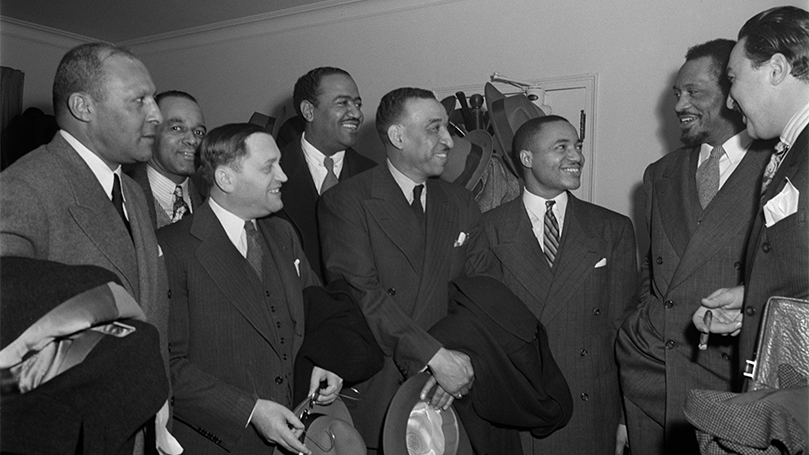
In 1943, Ben Davis, a national leader in the CPUSA and Harlem resident, was elected to the council after Adam Clayton Powell became the first African American elected to Congress from New York City. During the Cold War period, Davis would become one of the CPUSA national leaders sent to prison in the Smith Act political show trial (1949). After his release, he would fight for the right to speak on college campuses. In the 1960s, he was the first Communist to speak at City College; he was invited to speak by the Marxist Discussion Club.
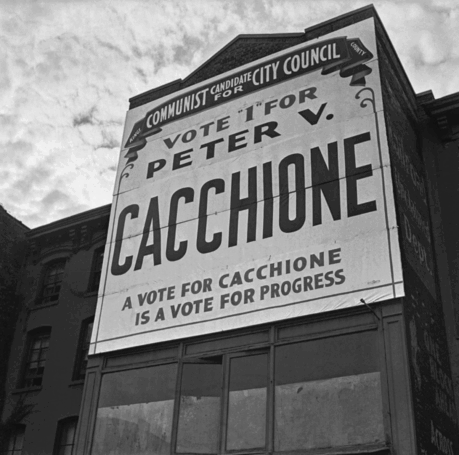 Pete would be reelected in 1943 and 1945. He would fight to defend the trade union movement from mounting attacks, maintain price controls in the midst of postwar inflation, and continue to expose and condemn racism and police brutality. After the passage of the Truman Doctrine, the Marshall Plan, and the Taft-Hartley Act — which reversed many of the gains the working class had made in the 1930s and barred Communists from holding positions in unions — the Democratic Party machine finally succeeded in abolishing proportional representation.
Tragically, Pete died of a heart attack five days after the abolition of proportional representation [clarification needed: please confirm that this is the correct antecedent]. His term was supposed to end on December 31, 1948. Although under city council rules he was supposed to be replaced by a member of his party, the council refused to seat Si Gerson as his successor, claiming that the CPUSA was not a “legitimate party.”
Faced with unrelenting repression by the capitalist political system in both good and bad times, Pete showed what a revolutionary could accomplish, just as Tom Paine and those artisans and farmers did in 1776. Pete represents the best of the American revolutionary tradition, which today seeks to free the nation from a corrupt tyrant.
More recommended reading
There are many fine works that readers should consult about Pete. Si Gerson’s Pete (New York: International Publishers, 1976) is the best starting point. International Publishers has a 2021 edition. Benjamin J. Davis Jr.’s Communist Councilman from Harlem (New York: International Publishers, 1969) is also a significant work.
Gerald Meyer’s Vito Marcantonio: Radical Politician (Albany: SUNY Press, 1989) is by far the best work on Vito Marcantonio. Meyer writes about Marc’s relationship with the CPUSA in an incredibly positive manner. One should also read Joelle Fishman’s tribute in People’s World, “Si Gerson, 95, journalist and electoral expert,” published on January 28, 2005, following his death. Si died in Brooklyn fifty-seven years after Pete’s death.
The opinions of the author do not necessarily reflect the positions of the CPUSA.
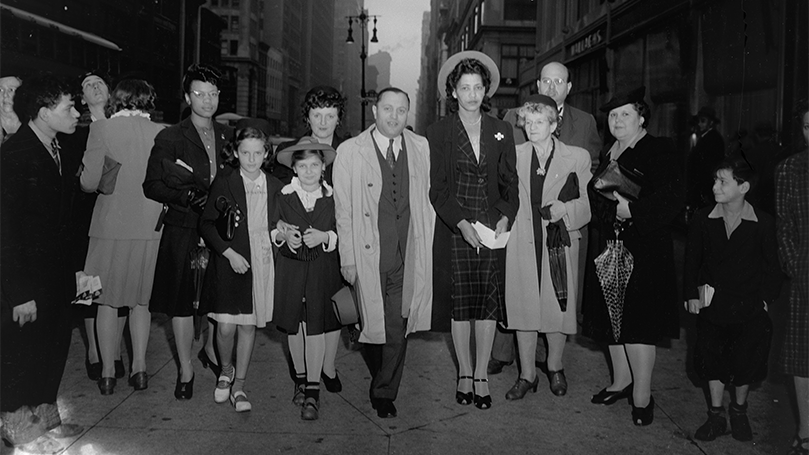
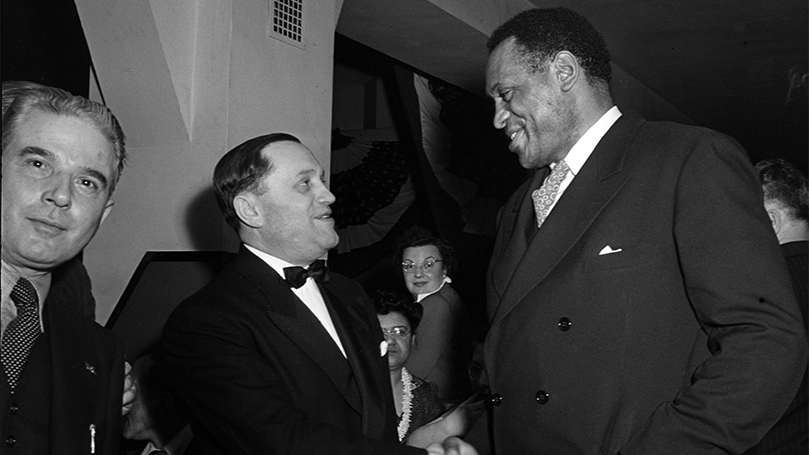
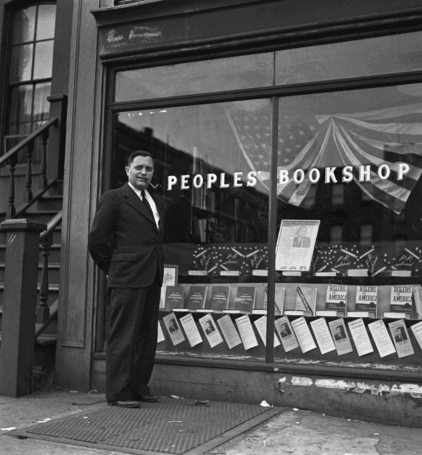
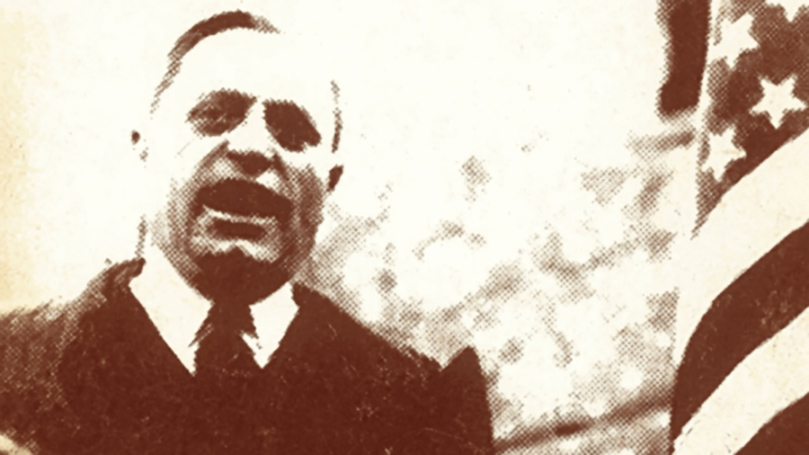
Images: Pete Cacchione and others. Public domain. Pete Cacchione and Paul Robeson. Public domain. Peter V. Cacchione in front of his campaign headquarters at 98 Fourth Avenue in Brooklyn, New York, September 21, 1937. Courtesy of Daily World / People’s World; Campaign mural for Peter V. Cacchione. Courtesy of Daily World / People’s World. Front cover of Pete: The Story of Peter V. Cacchione, New York’s First Communist Councilman by Simon Gerson (International Publishers).

 Join Now