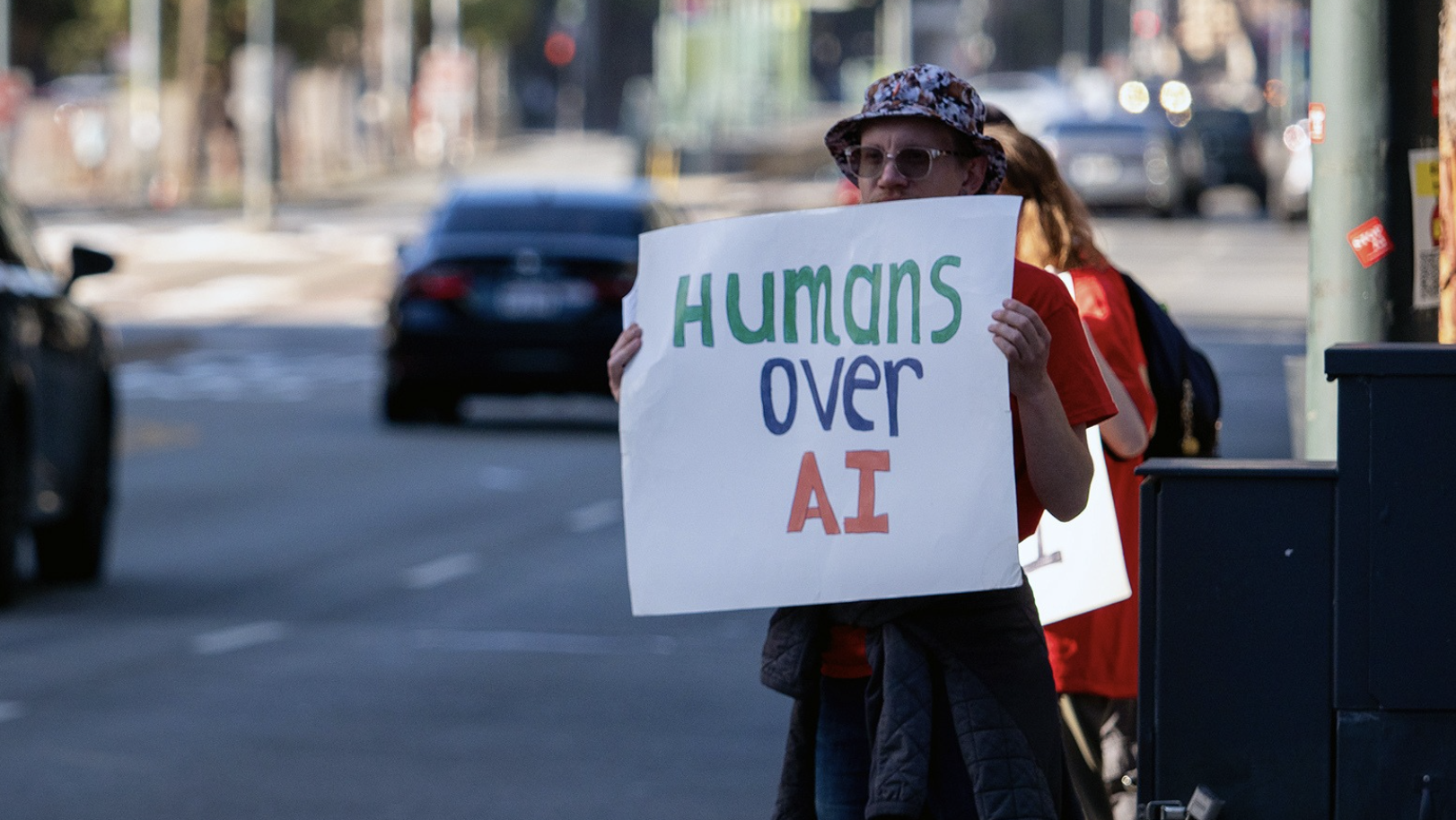
When leading AI CEOs suddenly called for an AI slowdown — pausing their cheerleading for “Artificial General Intelligence” (AGI) — to express “profound concerns” about a “serious alignment problem,” everyone took notice.
Since when have Elon Musk, Sam Altman, Dario Amodei, and other chip and platform hyperscalers expressed doubt about their multi-trillion-dollar rush toward AGI? Call it union skepticism or communist bias against dubious corporate altruism, but if those guys are worried enough to issue joint “self-critical” statements, it is about losing money — or making less than promised.
The real threat to the hyperscalers is public resistance to the drain on public and private capital required by the huge AI buildout of data centers and chip manufacturing. That buildout — the largest in human history — is just the tip of the iceberg if AGI is really on the agenda.
Along with Dean Baker, I submit that the billionaires’ goal is to head off “dreaded government regulation” and, worse, “public stakes” in AI, as called for by Bernie Sanders, the CPUSA — and even Bill Gates. Worst of all, to the billionaires, is the threat of losing the AI race entirely to socialism, meaning chiefly Chinese AI advances.
President Trump’s response was to convene the “worried” billionaires at the White House and announce, in summary: problem solved; with a strong U.S. president like him, China will not get the best AI and America will win the superintelligence race; and the hyperscalers can police themselves. This brief nod to Dean Baker’s question about the motives of the top monopolists dominating AI exposes a slew of geopolitical and geoeconomic realignments. For example, U.S. AI investment is roughly four times that of China.
Maybe the rising contest between “socialist” and “corporate-monopoly” development of AI is more significant than it first appears.
How serious is the bubble threat?
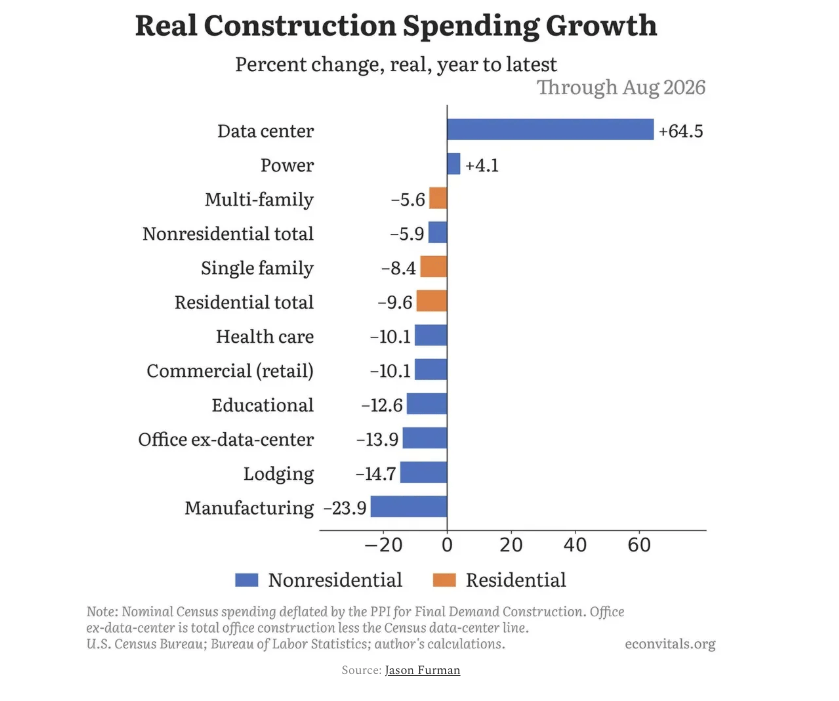
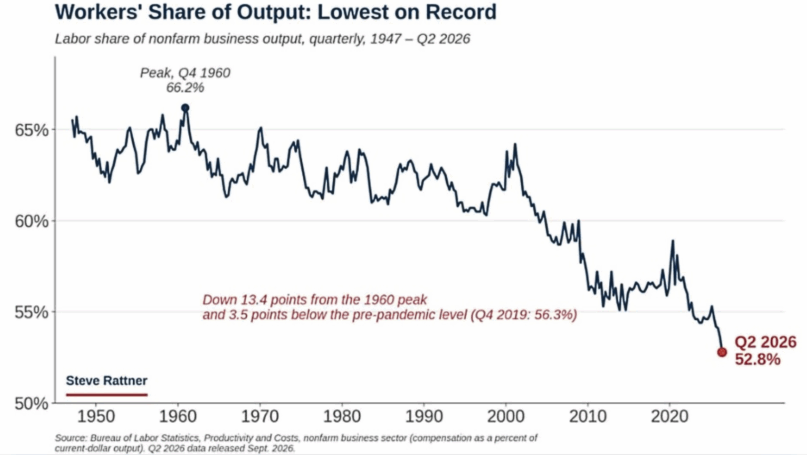
Paul Krugman recently dug into the numbers, with useful charts from Steve Rattner and Jason Furman.
“There has been very widespread discussion of the possibility that AI will worsen America’s already severe problem of income and wealth inequality,” Krugman wrote. “So far all the evidence suggests that investment in data centers comes at the expense of other investments. AI ‘crowds out’ other potential uses of capital. Because data centers employ so few workers, the vast spending on AI currently taking place will also significantly reduce the demand for labor.”
Jason Furman’s chart dramatically illustrates the concentration of, and dependence on, the massive AI infrastructure buildout. The data-center industry is incredibly capital-intensive and crowds out other investments. “Other things equal, the net effect will be to displace around 10 million jobs,” said Krugman.
Rattner’s charts show the long decline of the U.S. working-class share of wealth, old and new. So far, AI investment patterns are making the overall picture worse. The current rise in inflation and bond rates testifies to growing bubble risk — and to the even greater risk of devastation that could follow.
Very few investors beyond Nvidia and the hyperscalers are making money yet. As a sign of hesitation, the billionaires appear to be seeking financial as well as political cover. As recently as 2025, Facebook and Google were spending their own cash on massive data centers. Now, according to former Treasury Deputy Secretary Brad DeLong, they have shifted more to hedge-fund financing, reducing their direct exposure. Meanwhile, Nvidia is considering selling stock in its top-of-the-line chips as if the chips were separate operating businesses — millions of truly derivative financial instruments. Derivatives have a history of destroying the U.S. financial infrastructure — a very bad sign.
Seeing these charts, how can we not expect every vector of inequality and corruption in the U.S. to get worse? Is Trump’s poisonous racism, misogyny, labor hatred, and burning of the bridges built by the Roosevelt and Dr. King eras an aberration — or a reflection of monopoly capitalism’s deeper incompatibility with democracy itself?
AI generates general-purpose technologies whose scale and automation potential promise to increase labor productivity significantly. However, the scale of development, combined with increased concentration of capital, makes realizing these gains highly unlikely. Wherever abundance in commodity production is approached, the law of value argues for lower profits. Capital will strike long before that point. Only socialism can realize the gains of higher levels of economic development for the majority of us.
Mounting “affordability” problems show up in virtually every consumer market: food, housing, education, medical coverage, and clothing. Monopolies have become ubiquitous — energy, finance, insurance, food, drugs, media. Any “gains” are and will be consumed by monopolies.
The media monopolies are among the most dangerous. Elon Musk controls internet access across more than half the world. The hyperscalers are putting independent news services out of business. The broadcasting of egregious lies has become deafening. It is a “dictatorship of monopoly capital” behind nearly everything for sale.
The trade union movement and AI
In response to the rise of AI, the AFL-CIO has made a major effort to clarify key issues for workers regarding the technology. Its worker-centered agenda puts people first and requires worker input in R&D, deployment, and collective bargaining.
Key priorities include:
- Strengthen labor rights and collective bargaining: Without deeper union density and direct involvement in technological innovation, workers’ rights and living standards will suffer.
- Advance guardrails against harmful workplace AI: AI can monitor, evaluate, and control workers without their knowledge — causing stress, injury, burnout, turnover, and job loss.
- Protect copyright and intellectual property: Creative and sports workers otherwise face upended livelihoods and lost compensation, benefits, and future opportunities.
- Build a worker-centered training and “just transition” system: Direct worker involvement is key; “just transition” means no loss of living standards, with cash support where retraining is impractical.
- Institutionalize worker voice and transparency: Workers must be included in AI R&D, and black-box algorithms must not secretly determine hiring, promotion, discipline, or firing.
- Use procurement and civil-rights protections: Public tax dollars should not buy unsafe systems, and AI must not turbocharge bias and discrimination.
- Honor the three cardinal rules of solidarity: Take care of each other! Find useful and gainful work for everyone! Leave no one behind!

Socialist China and AI
Unlike in the U.S., the Chinese state directly intervenes in AI development and policy in several ways, according to several China Daily articles. In each case, the stated goals are to align AI development with the overall industrial policy of the state and the Communist Party.
Regulations require generative AI services to align with “core socialist values.” China enforces mandatory labeling rules for AI content, security assessments, and national standards for pre-training and fine-tuning datasets. The state acts as a non-controlling shareholder or strategic investor in many AI companies, ensuring it is well informed about AI firms’ activities; the state and Communist Party also have rights of access to much of the data used to train AI models, as well as being its source.
The rollout of AI in manufacturing must pass numerous safety checks, including plans for its impact on existing jobs and the division of labor. “Safety” in a broad sense is key to workers’ job security.
At the same time, highly innovative firms — whether for-profit, nonprofit, or under direct state control — could have a significantly dampening effect. Innovation is very much a trial-and-error process; you cannot manage the factors of production too conservatively.
The Chinese state heavily directs the buildout of large-scale data centers. Unlike the U.S. model, which concentrates computing power in a few private frontier labs, China’s state strategy pushes AI deep into traditional manufacturing, traffic management, and robotics across local regions.
AI presents a challenge that is simultaneously technical, social, and political. The copyright framework was built for an analogue world, where content was created by humans and territoriality provided a coherent organizing principle. AI deepens tensions already present in the digital environment regarding artists’ remuneration and transparency in the use of protected content, as AI companies gain immensely from using protected content while leaving rights holders without compensation.
What truly sets China apart is the speed with which innovations move from ideas to real-world applications. Supported by an extensive industrial ecosystem — from sensors and batteries to factories and supply chains — China can rapidly test, improve, and mass-produce AI products. China also leads in open-source AI, making powerful models available for others to download and adapt, lowering barriers for countries that lack resources to develop their own technologies.
As technologies move from laboratories to factories, the focus must shift from what machines can do to whether they can enhance human capabilities, solve practical problems, and enable more countries and people to share the benefits of progress.
No doubt there is a degree of spin in these China Daily accounts. Even so, the differences in emphasis are striking.

What is the “Commanding Heights” theory in Marxism-Leninism?
Vladimir Lenin used the military metaphor of “the commanding heights” (introduced around 1922) to describe the core, strategically vital sectors of the economy that the socialist state must retain under direct control to guide and secure the broader socialist transition and economic development.
In 1922, it meant heavy industry, large-scale production, metallurgy, fuel, coal, steel, railroads, transport, banking and finance, and foreign trade — in short, the monopolized corporate sector. Most of the “monopolies” had been awarded via favors from the Tsar; they were born corrupt and stayed that way.
State control did not necessarily mean outright nationalization, and as such was a tactical retreat from total state management (“War Communism” of the civil-war era) to the objective necessities of a mixed economy, but under Soviet leadership.
The Commanding Heights theory was reworked and greatly expanded by the Communist Party of China under successive generations of leadership, and took on new meaning under the “Reform and Opening Up” period starting with Deng Xiaoping.
Does the United States need its own commanding-heights theory and program to deal with the emerging billionaire dictatorship? I think so.
The question is not whether AI will be governed from the commanding heights. It will be. The question is who will occupy them: a billionaire dictatorship and its self-policing cartels, or a democratic, worker-led society that puts peoples’ and the planet’s needs first. The only “alignment problem” that really frightens the billionaires is alignment between AI and democracy.
The opinions of the author do not necessarily reflect the positions of the CPUSA.
Images: Humans over AI. Anders Eidesvik on Flickr; Jason Furman chart on Real Construction Spending Growth. econvitals.org; Workers share of output chart. Steve Rattner. U.S. Bureau of Labor Statistics (via the New York Times); Hands off protest. NW Labor Press; Governing AI for Good and For All conference in Shanghai, China. ITU Pictures on Flickr.
Author

John Case is a former electronics worker and union organizer with the United Electrical, Radio and Machine Workers (UE), also formerly a software developer, now host of the WSHC "Winners and Losers" radio program in Shepherdstown, W.Va.
 Join Now