The past has been a mint
Of blood and sorrow.
That must not be
True of tomorrow
A mom was running a bath when she noticed the discolored water. It was 1967. With her young family, she lived on the side of Hunters Mountain in Naugatuck, Connecticut. Neighbors reported the same discoloration. When diseases emerged, including cancers, she began focusing on the local landfill perched at the very top of Hunters Mountain.
That mom was Mary Lou Sharon. In the 1970s, she, along with some neighbors, told their concerns to local politicians. She was mostly dismissed as a housewife with nothing better to do. After all, the town and the Naugatuck rubber and chemical companies needed the landfill. Jobs were at stake. The town mayor, who knew a thing or two about political patronage, would have none of this nonsense from a housewife and “her” group.
The Naugatuck Rubber and Chemical Company worked with chemicals like benzene and toluene. Both are known as cancer-causing chemicals, or carcinogens. But there’s more, much more. The company was linked to the financial military industrial complex. It was part of the agent orange pipeline which was integral to the U.S. War in Vietnam. Ecocide is almost always a partner to genocide.
The local mayor issued threats. Garbage was strewn on the Sharons’ lawn. This was an established tactic of the mayor’s. Billy Rado, the mayor, was a former small grocery store owner who would have fit in wonderfully with Mussolini’s gang of fascist mayors.
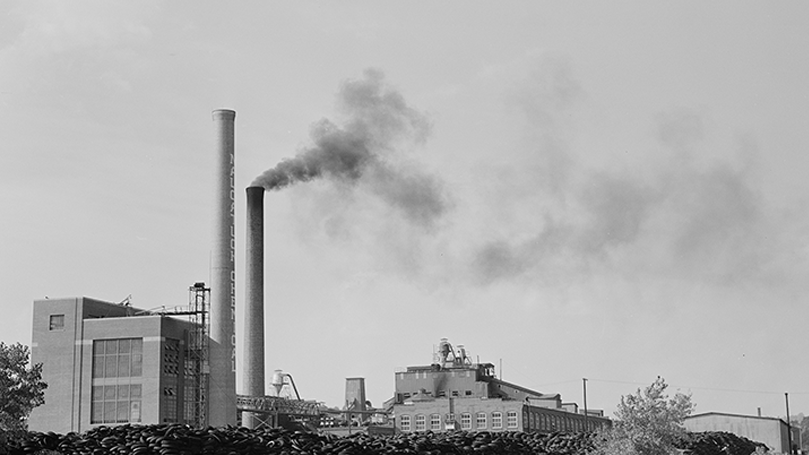
The short story of this prolonged Naugatuck Valley struggle resulted in the following: the landfill was found chock-full of nasty chemicals percolating into the homes and wells of some of the same workers who worked with those toxins in the shops below. The landfill was closed and the owner had to supply clean water to residents. The mayor was jailed for political patronage. The landfill was declared a superfund site. Mary Lou Sharon would eventually be recognized for her leadership in environmental struggles by the United Nations.
What other chemicals were brewing in this chemical soup?
If this later 20th century story sounded like scenes out of Henrik Ibsen’s 1882 play An Enemy of the People, you have the idea. If it sounded like the battle over forever chemicals in 21st century Hoosick, New York, you are spot on. To bridge these wide swaths of time, we have to go back to the end of World War I.
Chemical warfare and the spoils of war
It was 1919. Gas warfare, especially chlorine gas, was responsible for over one million casualties in WWI. Ruling class circles wanted German technological know-how to better commit mass murder on the battlefield.
In the U.S.A., it was none other than A. Mitchell Palmer who was their point man. Palmer worked for a company mostly funded by the DuPont company. Winning control of patents was part of the spoils of war. Patents yield profits.
Palmer said that chemistry and chemists would win the next war. This was the same A. Mitchell Palmer, U.S. Attorney General (1919-1921), who initiated the infamous Palmer Raids. In a red scare and racist hyped atmosphere, 10,000 were arrested, mostly immigrants. Hundreds more were deported.
Due to the notoriety gained for its smokeless powder, the DuPont Corporation became the focus of the efforts to use chemicals for war. Smokeless powder was important because troops had to see each other in order to kill each other. DuPont saw their WWI profits soar almost 10 times what they were before the war. It became the largest chemical company in the world.
There was a race to obtain German patents, eventually 4,500 of them. But why stop there? DuPont and other U.S. companies went directly after German chemists. They got two into the country quickly. The other two ended up at Ellis Island and were stuck there. It took a DuPont agent, posing as a member of an international police force, to get them in the country.
Chemists, in turn, tackled the problem of the “knocking” in fossil fuel engines. Besides the noise, it reduced the power of the engines. They solved this by adding lead to the fossil fuel.
On the shop floor, some people working with lead became impaired. Some died. When there was an uproar about it, DuPont lobbied the government to ensure there was no government oversight and no scientific studies into the impact of lead. That approach became the norm. Eventually, DuPont took over General Motors and sold this work in the 1930s to Nazi Germany.
The Kehoe Principle was a dream come true for industrial owners and a nightmare for those on the shop floor.
It was around this time that Professor Robert Kehoe of the University of Cincinnati codified this approach as “Trust industry. Products are safe.”
In fact, this became known as the Kehoe Principle. It was a dream come true for industrial owners and a nightmare for those on the shop floor. And, all too often, the nightmare spread to the surrounding community. What Friedrich Engels called social murder would abound.
The New Deal, Mass Struggle, and Fascist Pushback
In the 1930s, as the depression roared through the country, worker and community organizing reached a fever pitch. The election of Franklin Delano Roosevelt (FDR) was one outcome of this struggle. Enormous mass pressure resulted in what came to be known as the New Deal. It meant better working conditions on the shop floor, including rudimentary environmental regulations.
None of this sat well with big business, especially Sterling Clark, a member of the ruling class.
Nestled in the beautiful, bucolic Berkshire Hills of western Massachusetts is the multimillion-dollar Clark Institute of Art. Mr. Clark, an heir to the Singer Sewing Machine fortune, was a connoisseur of the art world. What he didn’t take a fancy to was a conscious working class on the move, the New Deal, and the dent these forces could make in his profits.
In 1933, Clark got together with Wall Street Investors, bankers at J.P. Morgan and some industrial cronies, like DuPont. The meeting had nothing to do with art but much to do with political power. The participants cooked up a coup attempt aimed at removing FDR from the presidency. They envisioned a Mussolini-type fascism.
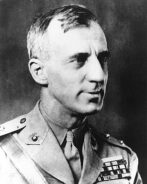
It didn’t happen. A Marine General, Smedley Butler, whom coup plotters tried to recruit, blew the whistle on them. When somewhat exposed, media moguls, in tune with the objectives of this fascist element, said there really was no coup attempted. Twenty-first century research revealed it was very much a plan for a fascist coup.
At this time, there were also fascist efforts at the grassroots. In Connecticut, the German American Bund, fascist led, attempted to set up a youth camp in Southbury, Ct. It was thwarted by a coalition of farmers, church leaders, and people who had ancestral roots in the revolutionary movements of the 1770s and 1780s. They saw the Bund camp’s threat to democracy.
Fascist threats came in different forms. In 1937, a cache of weapons and munitions was uncovered on an estate in Thompson, the “quiet” northeast corner of Connecticut. The Connecticut State Labor Convention passed a resolution calling on state agencies to put an end to fascist activity in the state. The owner of the cache, a rabid anticommunist and Nazi supporter, went to prison for the duration of WWII.
Undaunted, the financial military industrial complex marched forward. They had one of their best industrial friends in mind.
The Birth of Forever Chemicals
DuPont, in 1938, produced polytetrafluoroethylene (PTFE). This fluorocarbon solid behaved like a liquid plastic. It was strong yet flexible, slippery yet durable. The common name was Teflon. It was the first of a host of substances dubbed forever chemicals. The U.S. government, especially the dominant state monopoly capitalists, got interested right away. The war machine was having trouble with wires melting down in certain projects, especially the atomic bomb. Teflon could help.
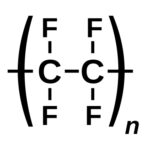 The molecular formula of Teflon is C2F4. Left is the structural formula. C is carbon, F is Fluorine, n signifies this unit is repeated many times, indicating this is a polymer.
The government turned to DuPont, already labelled “Merchants of Death,” to get productivity of these incredibly durable toxic chemicals to scale.
The government turned to DuPont to get productivity of these incredibly durable chemicals to scale. DuPont was reluctant at first. They already had the “Merchants of Death” label for playing footsie with the Nazis. But, in 1942, when FDR gave the go signal for the Manhattan Project and the atomic bomb, they saw megaprofits.
While Teflon wasn’t used in the nuclear bomb, other offshoots that combined carbon and fluorine were. In the 1960s this forever chemical would be used for potentially toxic nonstick “happy pans.” Now you will mostly see Teflon pans in flea markets and estate sales where they remain just as dangerous.
DuPont kept producing these “forever chemicals.” However, working with fluorine was dangerous. Workers were developing breathing ailments. There were explosions and deaths.
This was especially so in DuPont’s Chambers Works plant in southern New Jersey. Workers who were transferred there called it Devil’s Island, referencing the old French penal colony off South America. In the surrounding area of the plant, peach crops dried up and cows died. In their death throes, cows could be seen pushing themselves along on their stomachs in an attempt to graze.
The hue and cry went up for a government study and action. DuPont went into a defensive mode to protect their profits. DuPont said that they couldn’t reveal what was taking place. It had to protect its patents, read profits.
DuPont cosponsored research on a fluoride compound in Dr. Kehoe’s lab. An African American lab assistant and another worker were subjected to the chemical over a six-week period. While the chemical was tracked as it cruised through the men’s bodies, there was no attempt to check on the overall impact on their health.
In the summer of 1945, the U.S.A. dropped atomic bombs on Hiroshima and Nagasaki. It was yet another experiment by DuPont. They used a uranium-based bomb on Hiroshima and a plutonium-based bomb on Nagasaki. Cold War 1.0, and yet another red scare, would follow in its train.
Cold War 1.0 brought repression to the working class and to the Communist Party. It also engendered fight-back. “Ban the Bomb” demands broke out on U.S. streets, led by the CPUSA.
Baby Teeth and Radioactive Fallout
By the mid-1950s, concern was growing about nuclear testing. At that time, comrade Virginia Brodine was working for the International Ladies Garment Workers Union (ILGWU) in Saint Louis, Missouri. Brodine and scientist Barry Commoner, a former YCL member, “picked up the baton.”
Brodine and Commoner could see that an informed citizenry on all things nuclear was necessary. The Greater St. Louis Citizens Committee for Nuclear Information was born in 1958. It would bring scientists and citizens, along with Brodine’s organizational skills, together.
Out of this committee came the idea of a study of baby teeth, in particular searching for a radioactive chemical, e.g., strontium 90. The questions were (1) did radioactive fallout from nuclear bomb tests become ingested by cows from the grass they grazed? (2) Was that chemical, strontium 90, passed on to babies from cows’ milk?
After years of testing, including 300,000 baby teeth, the answers were yes. Similar studies spread to N.Y., LA, Montreal, Japan, and Germany.
These test results probably contributed, earlier, to the 1959 temporary halt to hydrogen bomb testing by President Eisenhower. It was followed by President Kennedy’s signing the Partial Test Ban Treaty in 1963. Chemistry was being learned at the grassroots.
Peace and environmental justice activism, along with trade union involvement, worked. The unity in struggle yielded powerful results.
Going into the 1960s, struggles continued. As in earlier days, industrial owners saw that profits soared when producing chemicals for the military. Among the most horrid examples, Dow Chemical and six other chemical companies produced Agent Orange, a defoliant. As previously mentioned, it had dire consequences for the environment of Vietnam, its people and U.S. military personnel. Peace protests broke out on college campuses.

Forever chemicals are everywhere
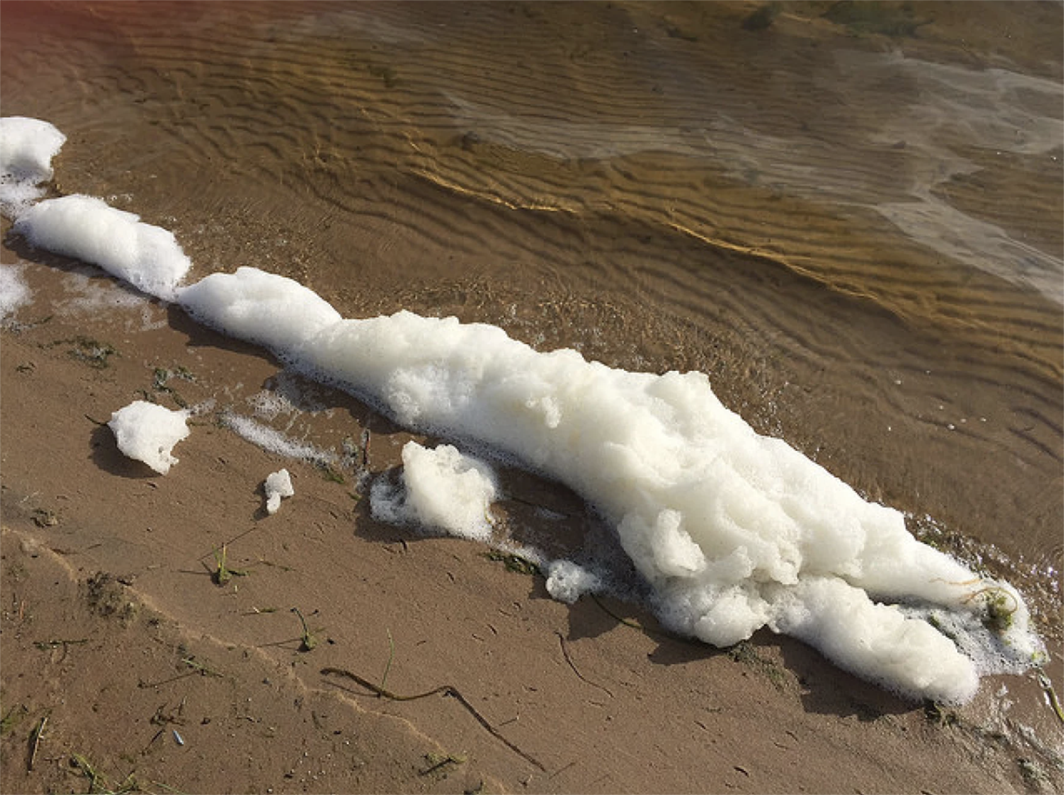
But there was much more coming that was flying under the radar for some time. Just as lead in gasoline and in paints would have severe consequences for the environment and people, the combining of carbon from fossil fuels with fluorine, as in Teflon, would be insidious. These are the compounds that would eventually be called the forever chemicals.
The forever chemicals have been associated with various cancers, especially kidney cancer, and with birth defects. To give an idea of how widespread these chemicals are, small carbon fluorine molecules were detected in eagles in remote areas of our country and in their eaglets. These chemicals are ubiquitous.
Humans are no exception. The vast majority of us, 99%, have forever chemicals in our bodies. Women pass “forever” chemicals through the placenta to the fetus.
The fight against forever chemicals has been led by the working class, organized in the community and in the shops. For example, in 2005, the Delaware River Keeper Network allied with the United Steelworkers Union (USW) to test water near DuPont plants in North Carolina, Virginia, and Ohio. Forever chemicals were detected in all samples.
From 2015 to present, in Hoosick Falls, N.Y., on the Vermont border, the fight-back against forever chemicals was, and still is, led by a doctor, now deceased, an insurance agent, and a nurse’s aide. They were up against DuPont, Saint-Gobain (a French company with 160,000 employees internationally) and Honeywell (a big-time military contractor with over 100,000 employees globally). With uncommon persistence at the grassroots, it was one case where a large settlement was won.
Hollywood Democrats, led by Jane Fonda, recently condemned forever chemicals. They even blasted California Governor Newsom (D), a potential presidential candidate, for vetoing a bill that would have stopped some of these chemicals, especially in pesticides, from being used.
They, however, stopped short of connecting these chemicals to the financial military industrial complex or of putting forth any historical context. Why? Many Democrats are loath to bite the hand that feeds them, especially congressional representatives who love to connect jobs, certainly not green ones, to that same cabal.
Further, Democratic, like Republican, administrations are directly connected to the imperialist project. A limited list includes President Johnson’s U.S. War in Vietnam, President Carter’s initial funding of foreign mujaheddin fighters in Afghanistan, President Clinton’s NATO bombing of Yugoslavia, and President Obama’s attack on Libya and yet another “surge” in Afghanistan.
The Trump Administration’s halting of the Cancer Alley lawsuit in Louisiana is a threat to all current and future attempts to stop pollution including “forever” chemicals. Other environmental justice victories, e.g., Naugatuck and Hoosick Falls mentioned here, are threatened with reversals.
The common enemy
Intertwining of the financial military industrial complex, pollution, and diseases, is a broad subject. Here we showed its initial push into the use of chemicals, especially the “forever” chemicals. Alongside that, from the early to mid-20th century, those same financial, military and industrial centers merged in our country to protect their interests and profits. It reveals incipient stabs at a rising fascist movement by ruling class elements.
The financial military industrial complex is the common enemy of both the peace and environmental movements and of all people. A worker-led just transition to a sustainable peaceful world is both the process and the goal. “This means,” Ellen von zur Muehlen said at CPUSA’s Peace Conference 2.0, “shifting our economy away from imperialism and extraction, and toward a future built on economic democracy, social justice, and ecological harmony.”
As Rossana Cambron said, introducing CPUSA Peace Conference 2.0, that “we need a new kind of peace movement – one that unites people fighting for peace abroad with those fighting for civil rights, immigrant rights, labor rights, environmental justice and equality for all.”
The opinions of the author do not necessarily reflect the positions of the CPUSA.
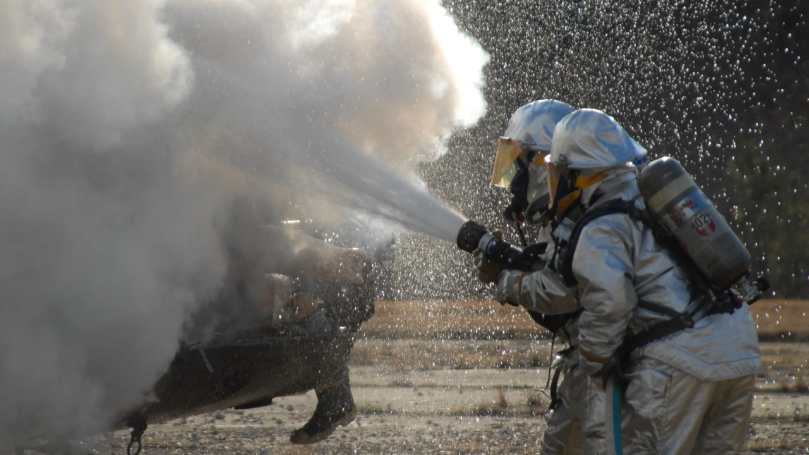
Image: Firefighters extinguish a helicopter fire during a training exercise in 2007 by U.S. Army Photo. Creative Commons. URI Launches Initiative to Study PFAS in R.I. Water Systems by Progressive Charlestown. CC BY-SA 4.0. The Naugatuck Chemical Company with piles of old rubber tires. Naugatuck, Connecticut by Jack Delano. Public domain license by U.S. Farm Security Administration of War. Smedley Butler by US Marine Corps. Public Domain. Structure of Teflon By Vectorization: Alhadis.Wikimedia Commons. Environmental Illness by Fred Barr/CPUSA. Creative Commons.
- Tags:
- anti-communism
- Barry Commoner
- Connecticut
- Connecticut State Labor Convention
- CPUSA Peace Conference 2.0
- ecology
- fascism
- Fascists
- forever chemicals
- German American Bund
- Henry Lowendorf
- New Deal
- Palmer raids
- peace
- Peace and solidarity
- Robert Kehoe
- Rossana Cambron
- Rubber industry
- Smedley Butler
- Virginia Brodine
- workplace safety
Author

Len Yannielli is professor emeritus, Naugatuck Valley Community College, Waterbury, Conn. He was the 2009 National Association Of Biology Teachers Evolution Educator of the Year.
 Join Now