Today, Labor Day 2026, is a time for U.S. workers, along with oppressed peoples and women, to celebrate the centuries of struggle and the wins that have done so much to shape what is good in this country. Anti-communists try to pit Labor Day in opposition to May Day, which is unabashedly socialist in origin. Their attempts fail, in the long run. The working class runs on unity; Labor Day is more than a day of families getting together and enjoying a day off. It, like May Day, is a celebration of struggle, and no amount of capitalist distortion of history can erase that truth. Today, people are engaged in anti-fascist get-out-the-vote actions all around the country.
The global workers’ struggle for the eight hour day provided the movement foundations for May Day, which came into existence after an international conference of labor and socialist organizations in Paris in 1889 called for demonstrations throughout the world for an eight-hour day on May 1, 1890. Out of these demonstrations a new International of socialist parties emerged and May Day became a world holiday. The strengths of Labor Day today grow from its roots in the struggle for labor-led democracy, equality, unity, and peace. And for socialism.
The true story of Labor Day
Labor Day also had its socialist origins. Peter McGuire, a poor Irish immigrant born in New York, went to work at the age of eleven after his father went to fight in the Union army. As a day laborer, McGuire learned socialist ideas from listening to German carpenters after the Civil War and attending lecturesThe Two-Front “Cold War” Against Labor Day and May Day at Cooper Union, built by the reformer Peter Cooper. He became active in New York labor circles as a young teenager after the war, attending meetings of the New York branch of the International Workingmen’s Association (First International), whose general secretary was Karl Marx.
McGuire was an early member of the Socialist Labor Party, the first Marxist socialist party in the country (1876). A powerful speaker-agitator, he became well known in working-class circles, calling for an end to the wage system and the establishment of public ownership of industry. McGuire now saw unions as the foundation for a socialist movement. Moving to St. Louis, he led a drive to organize carpenters, which was successful. He then led the campaign to organize a carpenters union, which resulted in the formation of the United Brotherhood of Carpenters, with McGuire as its general secretary.
In 1877, McGuire helped win the Missouri legislature’s support for one of the first Bureaus of Labor Statistics in the United States. Still in his twenties, McGuire was appointed deputy commissioner of the new bureau but resigned in 1879 to organize a union of carpenters. McGuire had come to see trade unions as indispensable to his socialist vision and to believe he should turn his energies to organizing and building a labor movement.
Within two years, McGuire had organized St. Louis carpenters and won such impressive wage gains for them that it attracted the attention of carpenters everywhere. McGuire then issued a call for a national meeting of carpenters’ unions in Chicago. The 1881 meeting resulted in the formation of the United Brotherhood of Carpenters (UBC). McGuire was elected UBC secretary, the organization’s chief administrative officer. That same year, McGuire wrote the convention call for the national conference of labor unions that established the Federation of Organized Trades and Labor Unions (FOTLU), which four years later became the American Federation of Labor.
McGuire organized the first demonstration that would become Labor Day in 1882. Shifting UBC headquarters to New York, he advocated a national march to secure an eight-hour day on the first Monday in September. The demonstrations spread to other cities.
McGuire also played a significant role in the U.S. development of May Day, the May 1 demonstrations for an eight-hour day that he introduced at a conference of the Federation of Trade and Labor Unions in 1884. Two years later, the May 1 demonstrations saw 350,000 marchers and resulted subsequently in the Haymarket Massacre in Chicago, which led to widespread police repression throughout the nation. In 1889, a global conference of labor and socialist organizations called for May 1 demonstrations in honor of the Haymarket martyrs — demonstrations that would result in both the formation of a new socialist international and the establishment of May Day as a global holiday.
Labor Day rally for struggle-oriented unionism
In the midst of a major depression, President Grover Cleveland, an enemy of trade unions whose administration had suppressed the American Railway Union’s Pullman Strike and imprisoned union leader Eugene V. Debs, declared the first Monday in September national Labor Day.
Committed to uniting the labor and socialist movements, McGuire found himself increasingly in conflict with Samuel Gompers, the leader of the AFL, who had abandoned his early socialist leanings to support “business unionism.” McGuire won the eight-hour day in many cities, but lost it in others. As the union grew, the rise of larger firms and the development of subcontracting in the building trades all had the effect of encouraging deskilling on the one hand and speedup and piecework systems on the other.
At the top, while labor generally was being deskilled, highly skilled specialty carpenters were hired who opposed broad union forms to unite all carpenters. McGuire remained committed to both socialism and to workers’ democracy, to decentralized control and administration of the union by workers’ representatives.
But he now faced powerful enemies. Local leaders demanded a stronger central structure, paid union leadership, professional organizers who in effect became business agents, union managers, who served as labor middlemen. They made deals with the employer to deliver specific numbers of skilled workers in the community at a specific time for a specific wage. These business agents became in effect the agents of class or social collaboration. They protected workers by cooperating with employers. Radicalism and socialism were to them anti-professional and against the interests of workers.
Often the business agents mimicked the employers’ style and dress, whereas McGuire and the labor radicals dressed and acted much more like the workers of the day and assumed an oratorical style, the style of political leaders of the working class.
The business agents often negotiated binding no-strike contracts in exchange for union label work, which encouraged conservative unions to grow.
They aspired to be bosses themselves, and some would move into contracting, learning to control labor as essentially labor managers. The system also bred, among a minority, labor racketeering, as business agent racketeers would in effect create complicated shakedown systems in various areas of work, exploiting both small businessmen and workers, and often using criminals to beat down both dissident workers and small businessmen.
This was especially true in transportation and distribution, among longshore and teamsters, in the building trades and garment industry.
Often, as was true later in a number of these industries, outright labor gangsters were supported over labor radicals by employers. Louis Lepke and Jimmy Hoffa are the best examples of this kind of “business unionism.”
McGuire’s final decade was tragic. In 1902, he was, as the AFL-CIO website contends, framed on an embezzlement charge and both removed from his leadership position and expelled from the Brotherhood of Carpenters. His decades-long tireless work and longtime heavy drinking took a major toll on his health. He died in 1906, although his reputation lived on among those trade unionists fighting for socialism.
The two-front “Cold War” against Labor Day and May Day
In recent years, scholarship has emerged claiming that another McGuire, Matthew McGuire, was the real founder of Labor Day. Matthew McGuire was likewise a militant trade unionist. He worked behind the scenes with Peter McGuire to organize the 1882 demonstrations that were the beginning of Labor Day. His work was significant, but it is very wrong to place him above Peter McGuire.
At the time, newspapers hostile to socialism claimed that Matthew McGuire was the “real father of Labor Day,” although he surprised many by running as the vice-presidential candidate of the Socialist Labor Party in 1896.
Today the website of the Department of Labor and newspapers like the New York Times have revived the view that Matthew was the real founder of Labor Day. However, it is important to know that the AFL-CIO website, on which this article was largely based, and the website of the Carpenters union, which expelled Peter in 1902, praise him today.
In the late 19th and early 20th centuries, the tendency toward business unionism was often challenged by workers fighting for workers’ democracy and control, in rank-and-file movements often with socialist leadership or influence. In the 1930s, Communist activists succeeded in building class-conscious industrial unions through the CIO in auto, steel, and other major industries.
These victories were greatly undermined in the post-World War II era when anti-Communist policies led to purges, blacklists, and a political climate of fear.
Then Labor Day was played against May Day, which was seen as “a Communist holiday” while Labor Day was hailed as an “American holiday” and an answer to socialism and communism. May Day rallies were denied permits and banned. In 1950, in New York, a May Day rally was brutally suppressed by police, with CPUSA members and others arrested and beaten.
In 1955, President Eisenhower proclaimed Loyalty Day as an answer to May Day, which Congress formally established in 1958. It has been rarely celebrated.
In the most extreme formal example, Trump, on May 1, 2025, proclaimed May 1 as both “Loyalty Day” and “Law Day.”
In 1933, the Hitler regime had established May 1 as “National Day” to hail the Nazi vision of Germany as it banned, arrested, and murdered Communist Party of Germany (KPD) leaders. In his proclamation, Trump sounded like Hitler when he claimed that on Loyalty Day, “we solemnly remember the more than 100 million victims of communism in the 20th century whose lives were viciously taken, and we stand in solidarity with the innumerable people across the world currently under captivity by communist leaders.”
Working people demonstrated on May Day in 2025 and 2026, as they will this Labor Day.
Today the labor movement is seeing a similar revival as it prepares to lead the broad people’s front to defeat Trump’s open, neo-fascist regime.
The opinions of the author do not necessarily reflect the positions of the CPUSA.
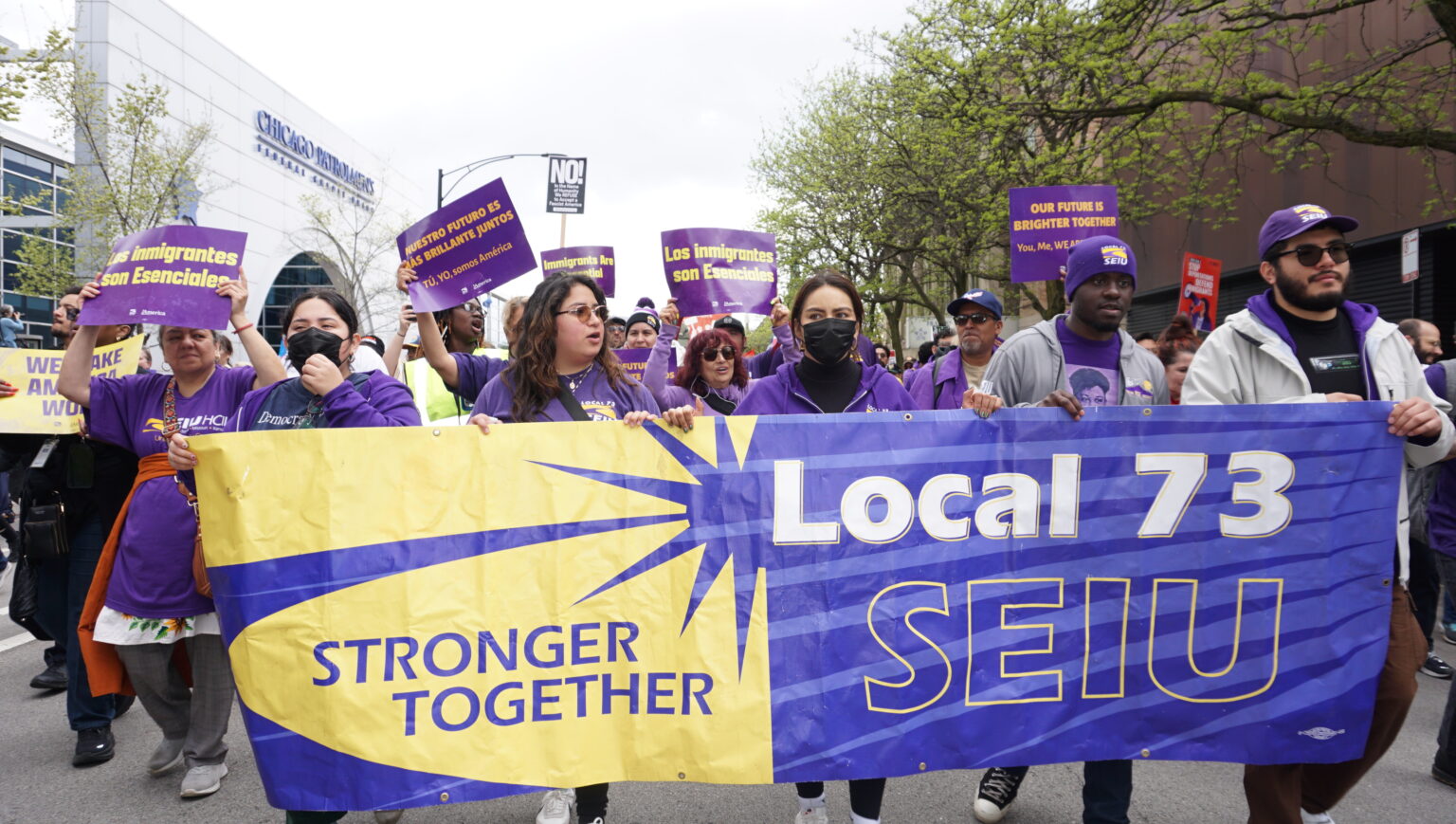
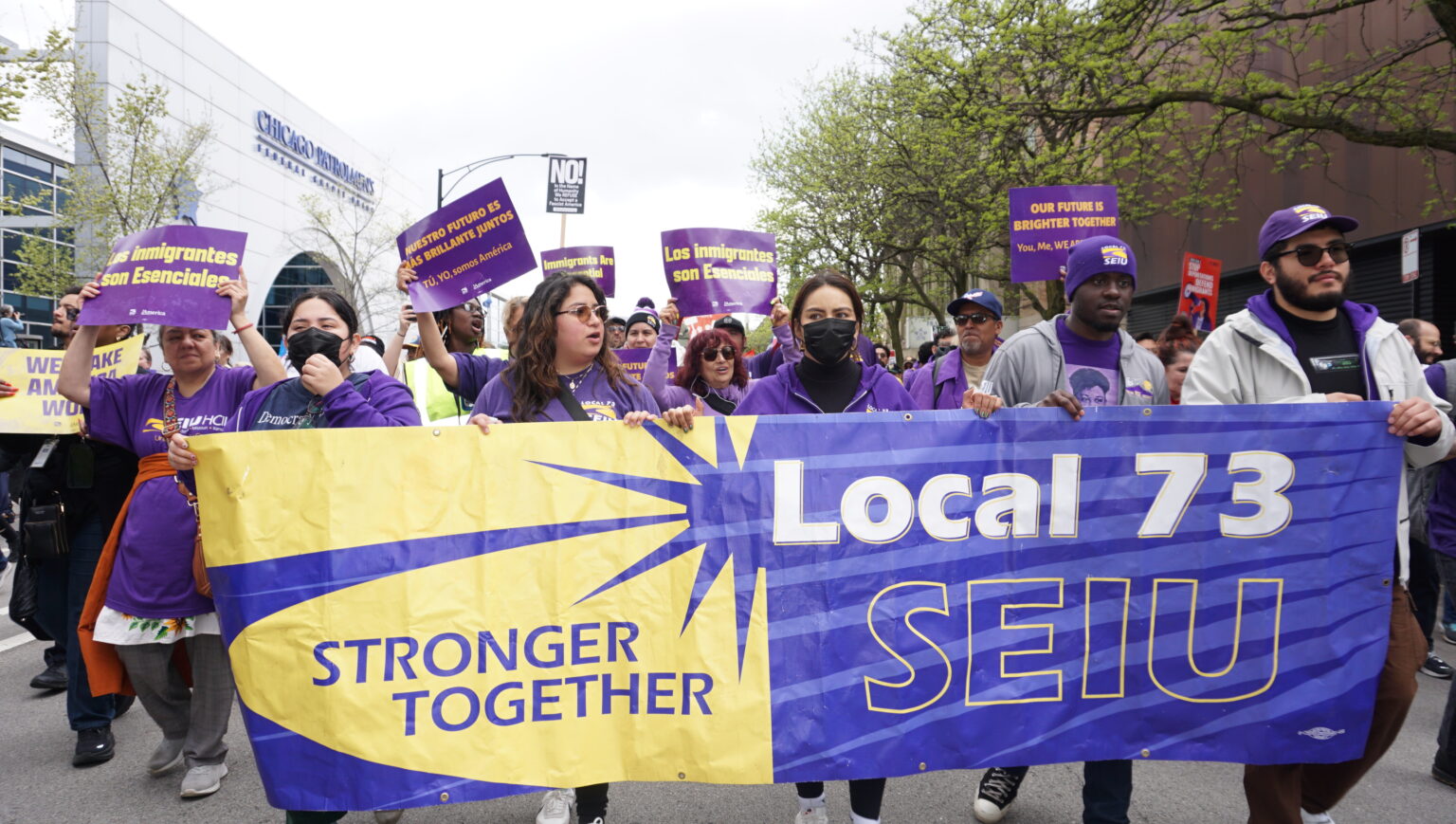
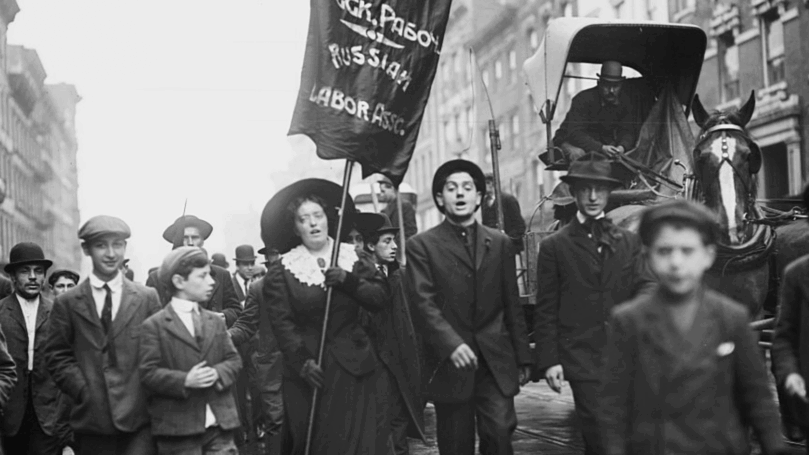
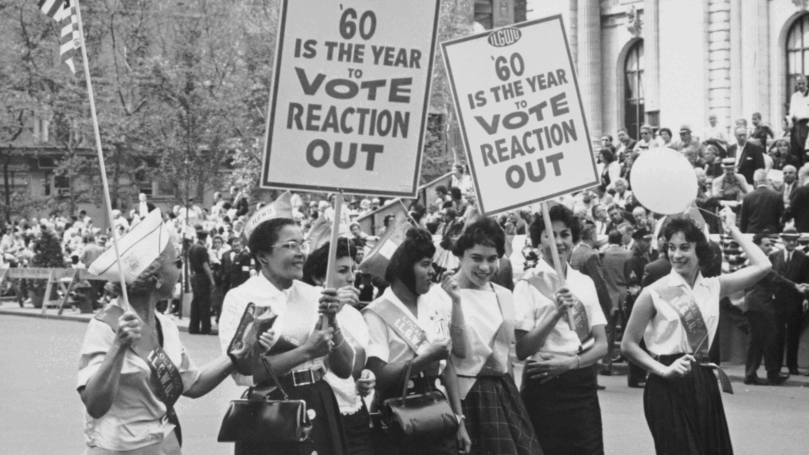
Images: SEIU Local 73 marches in Chicago. SEIU; Labor Day marchers in New York, 1909. Public Domain; ILGWU women marching in a Labor Day parade. Kheel Center on Flickr.

 Join Now