

Editor’s Note: This is the second edition of our Playlist for the People series. These suggestions are from people around the country who completed the Have a song to suggest for our political music playlist? form. Let us know your suggestions. Join in! Check out the first list in the series, compiled by Brooklyn Crawford, here. Building a culture of struggle through music, art, literature, theater, and every form of expression.
Tell me the options
Military service
Factory employment
Welfare assistance
The Proletariat were a punk band from southeastern Massachusetts whose explicitly socialist politics set them apart from their Boston contemporaries. Vocalist Richard Brown delivered lyrics like a “socialist provocateur at Hyde Park Corner,” demanding that listeners confront exactly how bad things had gotten for working people. “Options,” released in 1982, is a succinct description of the limited choices available to the American working class under capitalism. The song’s clean, angry, and urgent delivery made it a standout of the early ’80s hardcore punk scene.
New era ushered, but white supremacy is still in charge
Talking colonizing Gaza from the White House lawn
But the people mobbing, and we ain’t backing off
Finally see the oligarchy and the men that control us all
Macklemore released “F–ked Up” as a protest song taking direct aim at Donald Trump and Elon Musk. The rapper connects racial injustice in America to the administration’s ICE deportation efforts and calls out U.S. financial support for Israel’s genocide in Gaza, saying “Killing Palestinian kids and we getting hit with the cost.” The track continues Macklemore’s commitment to using his platform for political dissent, even as he faces backlash from mainstream audiences.
3. In the River by Raye Zaragoza
In the river is our sisters and our brothers
Raye Zaragoza wrote “In the River” in response to the Dakota Access Pipeline protests at Standing Rock. She was inspired by videos of security dogs being released on water protectors, and was heartbroken that the struggle was being overlooked by mainstream media. The song went viral overnight, garnering over hundreds of thousands of views and showing Zaragoza that music has a way of spreading awareness even for issues that are ignored.
4. Survive by Neighborhood Kids
Our music, our message is for liberation and freedom for all the people worldwide
The Neighborhood Kids are a hip-hop collective whose debut album VOICE OF THE REVOLUTION is filled with “resistance, unapologetic truth, and revolutionary hip hop energy.” Their song “Survive” widens the scope of the album. The group uses music as “public testimony, addressing systems of violence, confinement and resistance” without turning their songs into just political speeches. The hooks remain strong, the beats stay physical, and the words carry the force of lived conviction.
Process and dismissal
Forced removal of the people on the corner
Shelter and location
Everybody wants somewhere
Fugazi released “Cashout” in 2001, years before the 2008 subprime mortgage crisis, as a forceful critique of real estate developers and the local governments that cater to them. Ian MacKaye’s lyrics target the collusion between city officials and developers that displaces working people, calling out forced evictions and the greed that fuels gentrification.
We got the guillotine, you better run
The Coup, led by Boots Riley, released “The Guillotine” as a call-and-response disco burner that takes aim at the capitalist ruling class. Riley has explained the central line: “‘We got the guillotine’ means we have the power to get rid of the ruling class to create a classless society”. The song is an anthem for working people and its message is one of unity. It remains a staple of The Coup’s live shows and a rallying cry for revolutionary political music.
7. The Anti-Capitalistic Mentality by Sun Rise Above
I’m anti-capitalism, bashing the system
Smashing the prison walls, pound till it all falls down
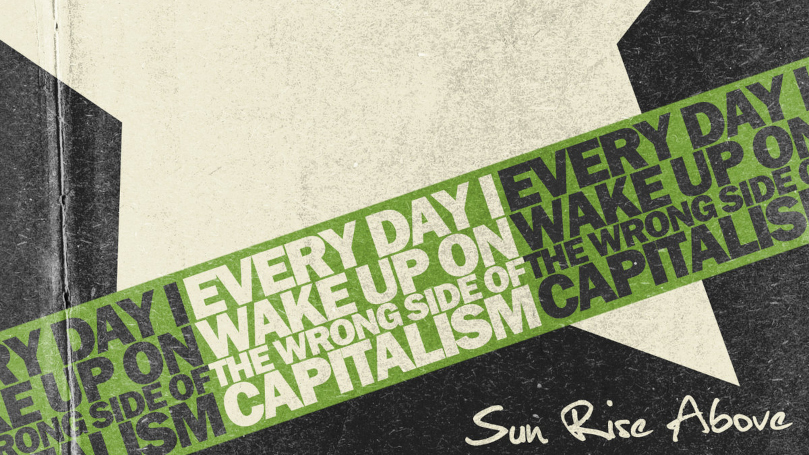
Sun Rise Above is a self-proclaimed Marxist rapper whose 2011 album Every Day I Wake Up on the Wrong Side of Capitalism is a 22-track assault on the capitalist economy. The song “The Anti-Capitalistic Mentality” has Sun declaring “I hate bosses, but I love working folk.” The track is a concise statement of anti-capitalist politics, delivered over a soulful R&B backdrop. Sun Rise Above positions himself as “the voice of the working poor,” and this song is a testament to his political convictions.
8. Please Mr. Foreman by Joe Lee Carter
Please Mr. Foreman, let me keep my job
Joe Lee Carter was a blues musician whose song “Please Mr. Foreman” gives voice to the anxieties of the working poor, particularly auto workers. The track appears on the compilation Work’s Many Voices Vol. 2, a collection of songs about labor and the struggles of working people. It is a plea from a worker to a foreman, a classic blues narrative of economic vulnerability and the fear of losing one’s livelihood. The song is a reminder that the blues tradition has long documented the realities of exploitation and survival under capitalism.
If you’re lackin’ control and authority
Come with me and hunt down minorities
Join ICE
Jesse Welles wrote “Join ICE” after seeing an ICE recruitment ad, and the song imagines the voice of a bottled-up agent: “There’s a hole in my soul that just rages / Well, the ladies turned me down / And told me I was a clown / Well, won’t you look at me now / I’m putting folks in cages.” The song went viral, racking up more than a million views, and became part of a minor comeback for the topical protest song in the new Trump era. Welles has been compared to Woody Guthrie for his wry, fingerpicked folk songs that respond to the headlines of the week.
10. Strange Fruit by Billie Holiday
Southern trees bear a strange fruit
Blood on the leaves and blood at the root
Billie Holiday recorded “Strange Fruit” in 1939, a song that brought the horror of lynching to the commercial record-buying public. The song was written by Jewish schoolteacher Abel Meeropol, a communist who adopted the sons of the Rosenbergs after their legal lynching in the McCarthy period. The song was, according to critic Leonard Feather, “the first significant protest in words and music, the first unmuted cry against racism.” In 1999, Time magazine named it the song of the century.
The opinions of the author do not necessarily reflect the positions of the CPUSA.
Image: The Anti-Capitalistic Mentality by Sunrise Above. CC BY-NC-ND 4.0.
Author

-
The Communist Party USA is a revolutionary working-class political party founded in 1919 in Chicago, IL.
The Communist Party stands for the interests of the American working class and the American people. It stands for our interests in both the present and the future. Solidarity with workers of other countries is also part of our work. We work in coalition with the labor movement, the peace movement, the student movement, organizations fighting for equality and social justice, the environmental movement, immigrants rights groups and the health care for all campaign.
But to win a better life for working families, we believe that we must go further. We believe that the American people can replace capitalism with a system that puts people before profit — socialism.
We are rooted in our country's revolutionary history and its struggles for democracy. We call for "Bill of Rights" socialism, guaranteeing full individual freedoms.
 Join Now