

The football season is here. There is a concept one hears over and over again in that sport. Next player(s) up. Meaning? With the game’s many injuries, especially to star players, the team with depth and with unity of mission has the best chance to win.
History is somewhat similar. It has stars too. Leaders, like Martin Luther King Jr., are very important. But one has to dig deeper to understand history. What class are they leading? Where are they leading them? What class is emerging? Where is nature in all this? And with the inevitable class struggle, what class has the best chance to “win”?
The book, Fossil Capital by Andreas Malm, attempts to answer these questions in the context of the transition from water driven mills to steam power. Coal was the fossil fuel readily available to generate that steam.
What better time than now to understand current imperialists prowling the planet for fossil fuels and minerals? What better time to understand, with deeper historical context, the wars and climate change that follow? What classes oppose the death and destruction that accompany this offensive of fascist-oriented capital?
The formation of fossil fuels, e.g., coal, methane, and oil, goes back millions of years in natural history. Coal, ignited by fire, was first used for heat and cooking. It goes back some three thousand years in human history in Asia, South America, and in various other places around the globe.
Fossil Capital’s ultimate concern is climate change. The many pollutants that accompany the burning of fossil fuels are not part of the book except one, carbon dioxide. Concerning the latter, the author posits the following: What’s its point of origin? When did carbon dioxide start impacting the planet’s entire ecosystem and us? When did it really start ripping?
To do this, it takes a background in the natural sciences and, especially, the science of society. One person equipped to attempt this is Swedish author and Marxist Andreas Malm. He is currently on the editorial board of the academic journal, Historical Materialism.
The crux of the book explicates how coal was wedded to a rising capitalist class in England. Malm more than tips us off with the title Fossil Capital. But here’s the rub. Look who tagged along with the meteoric rise of the bourgeoisie: the working class, which emerged fussing and fighting out of the grim scenes of soot, steam, and long working hours.
With the enhanced production power, facilitated by this fossil fuel, comes the first overproduction crisis of 1825. With steam generated power, everything speeds up. Spinning machines produce the cotton faster. Power looms weave the cotton faster. Some workers experience technological displacement with the initial thrust of steam power, but that’s just the beginning of major problems. Overproduction is built into the system. It’s structural.
There were now commodities, cotton based primarily but some others as well, sitting in storage, unsold due to overproduction. Commodities need a market to realize the surplus value — read profits — embedded in them. No buyers resulted in layoffs of that other class which was indispensably rising with the capitalist class: the working class.
So what about the workers who kept those machines humming? What were they to do? History tells us what some of them did. They attacked the machines.
Resistance of workers came fast and early, even before the structural crises of overproduction. One early morning in March of 1791, the mill in Albion, England, went up in smoke. Workers celebrated by singing songs in the streets of London. Up in Birmingham, owners of the means of production armed their staff. Class lines were being drawn. Game on.
In 1826, when the now systemic crisis of overproduction was sweeping the country, the Lancashire handloom weavers rose up. They smashed 1,000 power looms. This was big. Those taking action were beginning to acquire a name: “Luddites.”
Growing more powerful with each passing year, the capitalist owners sought state help. The British state responded by passing a law protecting private property. A paragraph of the 1827 law said it would be, henceforth, a felony to destroy the private property of the owning class. Translation. Dare to do it and you will swing from the highest gallows beam available.
Other violent methods were used to intimidate workers and stunt their actions. In 1834, some demonstrators in Oldham were murdered by “defenders” of the mill. The “intention” of the demonstrators, claimed the killers, was to damage machinery. The murderers were acquitted.
The reading of minds as evidence should sound familiar to anyone knowledgeable of the Cold War/Red Scare trials of the 1950s. The Smith Act trials are replete with charges of the “intentions” of communists to violently overthrow the U.S. government.

The moniker Luddites derives from an 18th century fellow named Ned Ludd. It was reputed that young Ned busted up some stocking frames for a reason lost in the sands of time.
Even among supporters of Luddites, there were those who dismissed the actions of the workers as childish. There was one person in another country who exclaimed, “Hold on a minute here.”
“There is more going on,” as is said, “than meets the eye.” It was Karl Marx.
In Prussia, it was Marx who said that one has to dig down beyond the outward appearance of these actions. What did he see that other pundits did not? There was a Luddite-type action in the south of what we now call Germany.
The weavers in Silesia were specifically going after records delineating private property. Herein lies a problem that the young Marx was beginning to theorize and to write about. Production was in private hands, mainly benefiting a few owners, while workers got crumbs.
The social nature of the work was ignored. Workers got tossed out into the cold when periodic structural crises hit. Women and children were, quite often, hired to do some of the work in its wake.
But there was even more. The weavers began targeting the financial backers of the cotton industry. Bells were going off in Marx’s head. It wasn’t just the owners of industry, it was finance capital, i.e. banks that ruled the roost. The abstract philosophy the young man was working out now had an active agent — the workers.
Marx heaped scorn on other writers for not taking the time to study the “specific character” of the weaver’s revolt in Germany. He further added, “Of course, this requires scientific understanding and a certain love of mankind.” At this early date, he clearly states that while blending reform with revolutionary work is the order of the day, it has to culminate with socialism.
Some might be surprised at Marx’s use of the word “love.” He often showed a love for humankind, including outside a workplace setting. He was, as Lenin would later codify, a “tribune of the people.”
Two years before his defense of the weavers, Marx came out swinging and writing on behalf of peasants. They were being tossed off land that they had used for centuries. They would glean the forest floor for nuts, berries, and mushrooms. Surface coal and dead branches of trees on the forest floor were used for heat. Grazing farm animals in meadows was also part of this activity.
The privatization push was happening to the land as well as work places. Marx wrote no less than five articles defending the peasantry. Because of his advocacy he, and his young family, were summarily tossed out of Prussia.
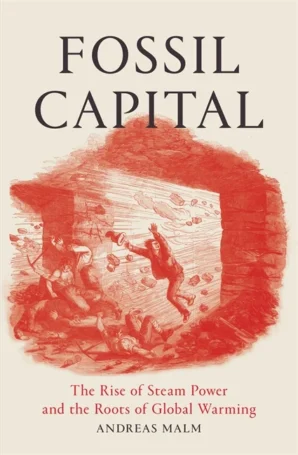 Back to Fossil Capital. Malm makes it crystal clear, and with detailed examples, that land privatization in England was part of a dialectical process involving coal and steam driven production. The latter allowed a move from water driven mills in the countryside to urban centers. Hands were needed to run the steam engines. Now those hands were being supplied by a forced migration, the enclosure acts.
Just as there was death and dying with the forced removal from the land, the transition to urban life had its hardships and casualties too. Layoffs made for desperate measures by families. Some contracted their children to hucksters who used the smallest of them to crawl up chimneys in a primitive cleaning process. Deaths, some quick, some drawn out, happened in those stacks.
Cotton was picked by slaves in “far away” colonies. Vast areas of forests were cleared to grow the crop. It was shipped to manufacturing sites for spinning cotton thread. These would be the stuff of clothing commodities.
Cotton was quite often implicated in the early boom/bust cycles of capitalism. Along with that came carbon dioxide and water vapor entering the atmosphere from the fossil fuel driven production process. Those, along with oil and methane, are still the main drivers of climate change.
Here the author enters the debate on the use of the term “anthropocene” to represent our current period. It lays all the environmental problems, especially climate change, at the feet of all humans. The author disagrees. It, too easily, lets capitalists off the hook.
The author peels back further in history when coal was substituted for wood in a much bigger way for heating domiciles. It was almost immediately also used in very early small manufacturing, potteries, and smitheries. This date, 1560, is referred to as the “Elizabethan Leap.”
Enter the author’s main thesis. It was capitalists seeking more and disciplined labor in urban centers that facilitated the switch from water, as a source of power, to steam now powered by coal fires. Avoiding weather fluctuations impacting water levels was another reason. James Watt’s invention of the steam engine (1781) does play a role but is downplayed by the author.
The author explains how values are created reminiscent of the first 100 pages of Marx’s Capital. He shows how a capitalist’s money buys labor power to make more money. He represents this by:
M—C—M’
M equals money. The C here represents the commodity of labor power, that is the ability to do work. Now for a more nuanced look at how the capitalist ends up with more money (M’).
M—C—P—C’—M’
The P is production. It is packed with processes, some observable, some hidden. Marx’s dictum that all wealth starts with the earth, here coal and let’s posit cotton, enters here. It results in the commodity (C’) cotton threads being produced. What is also embodied in C’ is the labor time by the potential of C being realized. The process yields added value. That surplus value — think profits — materializes with M’.
In terms of carbon dioxide, an invisible vapor, most emissions occur within the commodity production (P) process.
In the England of the 1830s and 1840s, Chartism had universal suffrage as its central focus. Its main base was in the textile industry.
Here the author of Fossil Capital takes a detour from the first 300 pages, mostly in 19th century England, to 21st century China. Was this to establish his anti-communist bona fides to get his book, which is mostly anti-capitalist, working class history, published?
It might be more a question of tone. It has been well established that the U.S., and China in more recent history, contribute mightily to carbon in the atmosphere. Of course, it was industrial centers in the 1950s, which survived the ravages of war, that sent carbon emissions ripping into the atmosphere. It continues. When counting all cumulative CO2 emissions from 1870 to 2014, one fourth have streamed into the atmosphere in the last fifteen of those years.
There is no separate chapter on the U.S.
Malm does point out China’s contributions in the production of solar panels. In 2025, China exported $117 million of solar equipment to Cuba. By 2028, China is aiding Cuba in the building of 92 new solar parks. This will be enough energy to supply electricity to 1.5 million homes.
The index is incomplete. Lenin, who is referred to in a number of instances, is not there. Trotsky, who is referred to once in the book, is.
Since the printing (2016) of this valuable book, Fossil Capital, Andreas Malm has called for “eco-terrorism.” This centers on the sabotage of fossil fuel hardware, going so far as to publish the book How to Blow Up a Pipeline (2021). The latter book was emphasized in the January 2024 Time Magazine interview, with Malm’s portrait on the front cover.
Malm’s Fossil Capital, which is based on his PhD thesis, details the reasons for the shift from the mills that depended on water wheels in the countryside to steam driven shops in urban centers. He claims that it was not so much driven by the James Watt invention of the steam engine but points made earlier in this review. Unlike some PhD theses at book level, Fossil Capital is quite readable.
Malm seems to imply that his analysis is fundamentally different from the Marxist classics. His reading of the latter is that there is too much emphasis on the forces of production. Certainly, there is a dialectical relationship between production forces and production relations. Malm expresses this at times, then seems to forget it.

Fossil Capital makes the following very clear. Fossil fuels and a rising capitalist class were wedded together from the get-go. They still are. You can’t have one without the other, no more than you can have Generation Z without smart phones. The only way to rid ourselves of fossil fuels is to dump the capitalist system and to move on to the socialist solution.
Malm agrees with the first part of the above but not the second. In subsequent writing, he explains that even with socialism, it would be far too late for us and the planet. He advocates, and participates in activities he can’t reveal, eco-terrorism. He calls it sabotage or vandalism. Do not hurt people, only the equipment of the fossil fuel complex.
Malm claims his eco-terrorism is similar to the tactics employed during South African struggles in the 20th century. How confused is that?
He is referring to a national liberation struggle that was led by the African National Congress (ANC) with the backing of trade unions and the South African Communist Party (SACP). International support, especially when dock workers refused to handle South African products, was very important. In other words, the working class was a leading force. Where is that kind of support for the eco-terrorism he supports?
The politics of frustration cannot substitute for organizing a vibrant climate justice movement while working toward working class leadership of it. Malm’s book, first published ten years ago, can be helpful in that effort.
Fascist forces, worldwide, have put imperialism and climate change on steroids. The clash with working classes and other progressive forces is also happening.
The CPUSA has called for a popular front against fascism. Game on.
The opinions of the author do not necessarily reflect the positions of the CPUSA.
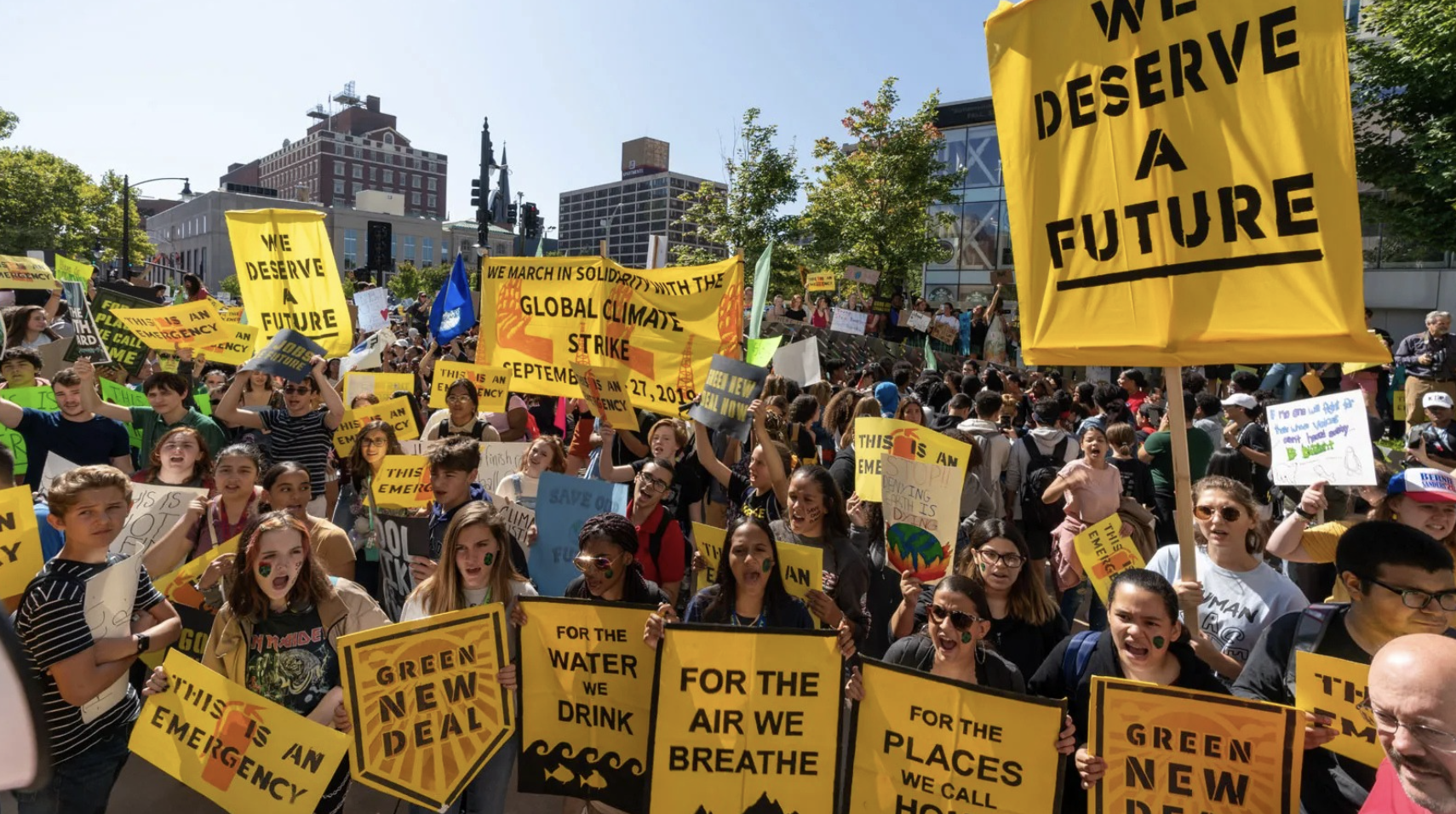
Images: Sunrise Movement demonstration. Gabriel Civita Ramirez on Flickr; Union members hold signs at a press conference announcing the launch of Climate Jobs Oregon. Oregon AFL-CIO; Veterans For Peace march to demand end to global warming and wars. Veterans for Peace.
Author

Len Yannielli is professor emeritus, Naugatuck Valley Community College, Waterbury, Conn. He was the 2009 National Association Of Biology Teachers Evolution Educator of the Year.
 Join Now