

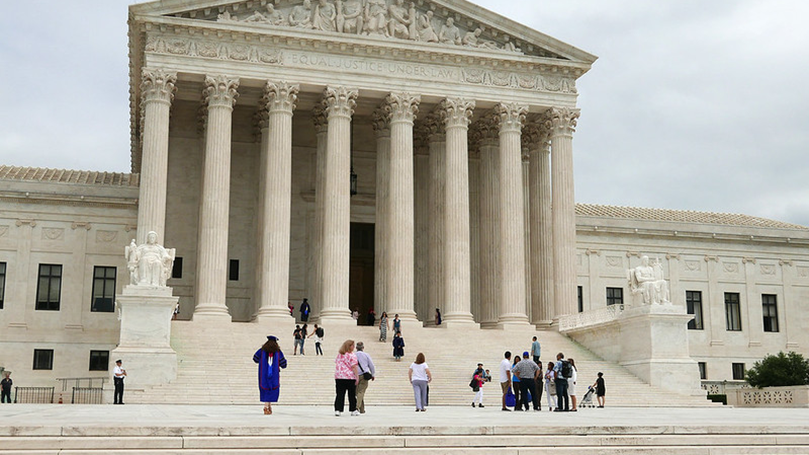
The Supreme Court’s 2025-26 term has ended with its late-term decisions and opinions causing much discussion and analysis. The following is a rundown on some of the most talked-about decisions.
Asylum seekers
In a 6-3 vote along ideological lines, the Court in Mullin v. Al Otro Lado held that the Immigration and Nationality Act does not require border officials to allow every person waiting at a port of entry to enter U.S. territory to file an asylum application. It concluded that the government may lawfully regulate access to ports of entry and may temporarily turn away asylum seekers when border facilities are at capacity. The case involved the legality of the federal government’s metering or turnback policy at ports of entry on the U.S.-Mexico border. Under that policy, border officials limited or prevented asylum seekers from physically reaching U.S. territory to request asylum. Writing for the majority, Justice Alito emphasized that Congress gave the Executive Branch broad authority to administer the border. Moreover, a person waiting outside the border has not necessarily arrived in the U.S. for purposes of the asylum statute, and courts should defer to the Executive’s operational decisions regarding border management. In her dissent, Justice Sotomayor, joined by Justices Kagan and Jackson, argued that the majority undermines Congress’s statutory guarantee that noncitizens arriving at ports of entry may apply for asylum. The dissent warned that the ruling could leave vulnerable migrants stranded in dangerous conditions outside but near the U.S. border. The decision gives the Executive Branch substantially greater flexibility to manage border crossings and is widely viewed as a significant narrowing of practical access to the U.S. asylum system at ports of entry.
Presidential executive power
In Trump v. Slaughter, the Court held that Congress may not constitutionally prevent the president from removing Federal Trade Commission (FTC) commissioners at will. The decision overruled the near-century-old precedent of Humphrey’s Executor v. United States, which had allowed Congress to give FTC commissioners for cause removal protection. In March 2025, the President removed FTC Commissioner Rebecca Slaughter before the expiration of her term, despite the FTC Act permitting removal only for cause, i.e., inefficiency, neglect of duty, or malfeasance in office. Slaughter unsuccessfully challenged her dismissal relying on Humphrey’s Executor. Justice Roberts, writing for a 6-3 majority, concluded that the Constitution vests the executive power in the President and that officers exercising executive authority must remain accountable to the President. Justice Sotomayor, in her dissent, argued that the Court discarded nearly a century of settled constitutional law. According to the dissent, independent agencies were created to prevent political interference in specialized regulatory decisions, and Congress has authority to structure agencies in this manner. The dissent warned that the decision significantly expands presidential authority at the expense of Congress’s ability to design independent regulatory institutions. The Court also issued a separate decision, Trump v. Cook, on the same day. There, the Court declined to allow the President to remove a member of the Federal Reserve Board, treating the Federal Reserve as constitutionally distinct because of its unique role in monetary policy. Thus, while the Court in Slaughter greatly expands presidential removal power, it did not make all independent agencies removable at will.
Transgender athletes
In a 6-3 vote, the Court upheld laws in West Virginia and Idaho that prohibit transgender girls and women from competing on girls’ and women’s school athletic teams. The majority held that these laws do not violate either the Equal Protection Clause of the Fourteenth Amendment or Title IX, the federal law prohibiting sex discrimination in federally funded educational programs. Justice Kavanaugh’s opinion emphasized several points: States have a legitimate interest in preserving sex-separated athletic competitions based on biological sex; legislatures may conclude that biological differences can affect fairness and competitive opportunities in certain sports; the Equal Protection Clause does not require states to permit transgender girls to compete in girls’ sports; and Title IX allows schools to maintain separate athletic teams based on sex. The Court emphasized that its decision was limited to school athletics and did not address questions involving transgender rights in other settings. Justice Sotomayor was joined in dissent by Justices Kagan and Jackson. The dissent argued that both West Virginia and Idaho state laws discriminate based on transgender status, and that states failed to justify categorical exclusions of transgender athletes regardless of individual circumstances. Finally, the dissent argued that the majority interpreted both the Equal Protection Clause and Title IX too narrowly, and in doing so, denied transgender students equal protection opportunities.
Birthright citizenship
In Trump v. Barbara, the Court held that the Fourteenth Amendment guarantees U.S. citizenship at birth to children born in the U.S., regardless of whether their parents are undocumented immigrants or are lawfully present but only on a temporary visa. The Court struck down President Trump’s executive order that sought to deny citizenship to those children. Chief Justice Roberts wrote that the Citizenship Clause provides citizenship to all persons… “born in the U.S., and subject to the jurisdiction thereof.” The Court’s majority relied heavily on the text of the Fourteenth Amendment, United States v. Wong Kim Ark (1898), more than a century of historical practice, and the federal citizenship statute. The decision represents one of the Court’s most important constitutional rulings on immigration since Wong Kim Ark, where the Court ruled that the Citizenship Clause of the Fourteenth Amendment guarantees U.S. citizenship to almost anyone born on American soil, regardless of their parents’ race, nationality, or immigration status.
The opinions of the author do not necessarily reflect the positions of the CPUSA.
Image: The U.S. Supreme Court by Susan Melkisethian. CC BY-NC-ND 2.0.
Author

Patrick N. Chapin is a retired litigator, trial attorney, and ordained Buddhist Priest in the Navayana tradition.
 Join Now