

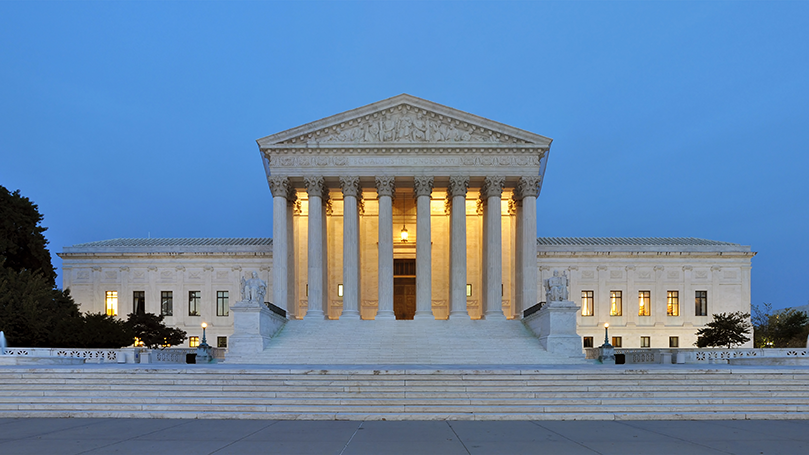
The debate over “packing” the United States Supreme Court is almost as old as the Court itself. Despite popular belief that the phrase refers to expanding the number of justices to change the Court’s ideological balance, the size of the Court has changed several times in American history. What makes the “court packing” controversial is not merely changing the size but doing so primarily to influence judicial outcomes. The following endeavors to explain the historical development of the Court’s size.
The Constitution empowers Congress to determine the size of the Court. The United States Constitution establishes “one supreme Court,” but does not specify how many justices it should have. Congress determines the number by statute. The Court’s size has changed repeatedly:
| Year | # | Reason |
|---|---|---|
| 1789 | 6 | Original Judiciary Act |
| 1807 | 7 | New judicial circuit added |
| 1837 | 9 | Expansion as the nation grew westward |
| 1863 | 10 | Civil War era expansion |
| 1866 | 7 | Reconstruction politics |
| 1869 | 9 | Set at today’s size |
Changes throughout the 19th century often had political motivations. Even before the term “court packing” existed, presidents and Congress used changes in the Court’s size as a political tool. In 1801, the outgoing Federalists reduced the Court from six to five seats before Thomas Jefferson took office as a tactic to deny him an appointment. However, after Jefferson’s allies gained power, they repealed that law in 1802 before the reduction ever took effect. Years later during the American Civil War, Congress expanded the Court to help Abraham Lincoln appoint another justice. After Lincoln’s assassination, the Republican Congress had no trust for Andrew Johnson and reduced the Court’s size to prevent him from making appointments. But once Ulysses S. Grant became president, Congress restored the Court to today’s size of nine justices in 1869. These examples demonstrate that Congress has a documented history of using its authority over Court size for political purposes.
Franklin D. Roosevelt arguably made the most unsuccessful attempt to expand the Court. During the early years of the New Deal, the Supreme Court struck down several major pieces of FDR’s New Deal legislation. After winning reelection in a 1936 landslide, FDR argued the older justices were overworked and proposed allowing the president to appoint one additional justice for every sitting justice over age 70.5 who refused to retire, up to six additional justices.
This could have increased the Court from nine to as many as fifteen members. Supporters argued the Court was preventing elected government from addressing the Great Depression, and older justices needed help with an increasing workload. Moreover, since the Constitution does not specify nine justices, Congress had full authority to change the number. Opponents argued the real purpose was to create a Court favorable to FDR’s policies, and judicial independence would be undermined. A more familiar argument in opposition is that future presidents would simply add even more justices whenever they disliked Court decisions. Opposition at the time came not only from Republicans but also from many Democrats, including prominent members of FDR’s own party. FDR’s proposal ultimately failed in Congress and is widely regarded as one of his greatest political setbacks. It is interesting that while FDR’s proposal to pack the Court was pending, the Supreme Court began rendering decisions upholding key New Deal laws. Many at the time described this as “the switch in time that saved nine,” suggesting the Court changed course because of FDR’s proposal. However, modern historians are divided. Some see political pressure as influential, while others argue the justices’ votes were consistent with legal positions they had already been developing.
Since 1937, proposals to change the Court’s size have periodically resurfaced but have not been enacted. Recent arguments for expansion are that it would correct what supporters view as partisan manipulation of judicial appointments or restore ideological balance. Considering it further, advocates for expansion believe it would make the Court more representative of contemporary public opinion and provide a response to controversial decisions viewed as departing from constitutional principles or establishing precedent. More current arguments against expansion are that it starts an escalating cycle in which each party adds more justices after gaining power, resulting in weakened public confidence in judicial independence. It might make the Court appear to be simply another political institution.
Changing the size of the Supreme Court is not itself unprecedented since Congress did so six times between 1789 and 1869. What makes the term “court packing” distinctive is that it usually implies changing the Court’s size primarily to alter its ideological composition, rather than for administrative reasons. That is why FDR’s 1937 proposal has become the defining example of American political history. Today’s debate during a polarizing time is therefore less about whether Congress has the constitutional authority (which it does) and more about whether exercising that authority for ideological reasons would strengthen or weaken the constitutional system over the long term.
The opinions of the author do not necessarily reflect the positions of the CPUSA.
Image: Panorama of United States Supreme Court Building at Dusk by Joe Ravi. CC-BY-SA 3.0.
- Tags:
- Supreme Court
Author

Patrick N. Chapin is a retired litigator, trial attorney, and ordained Buddhist Priest in the Navayana tradition.
 Join Now