

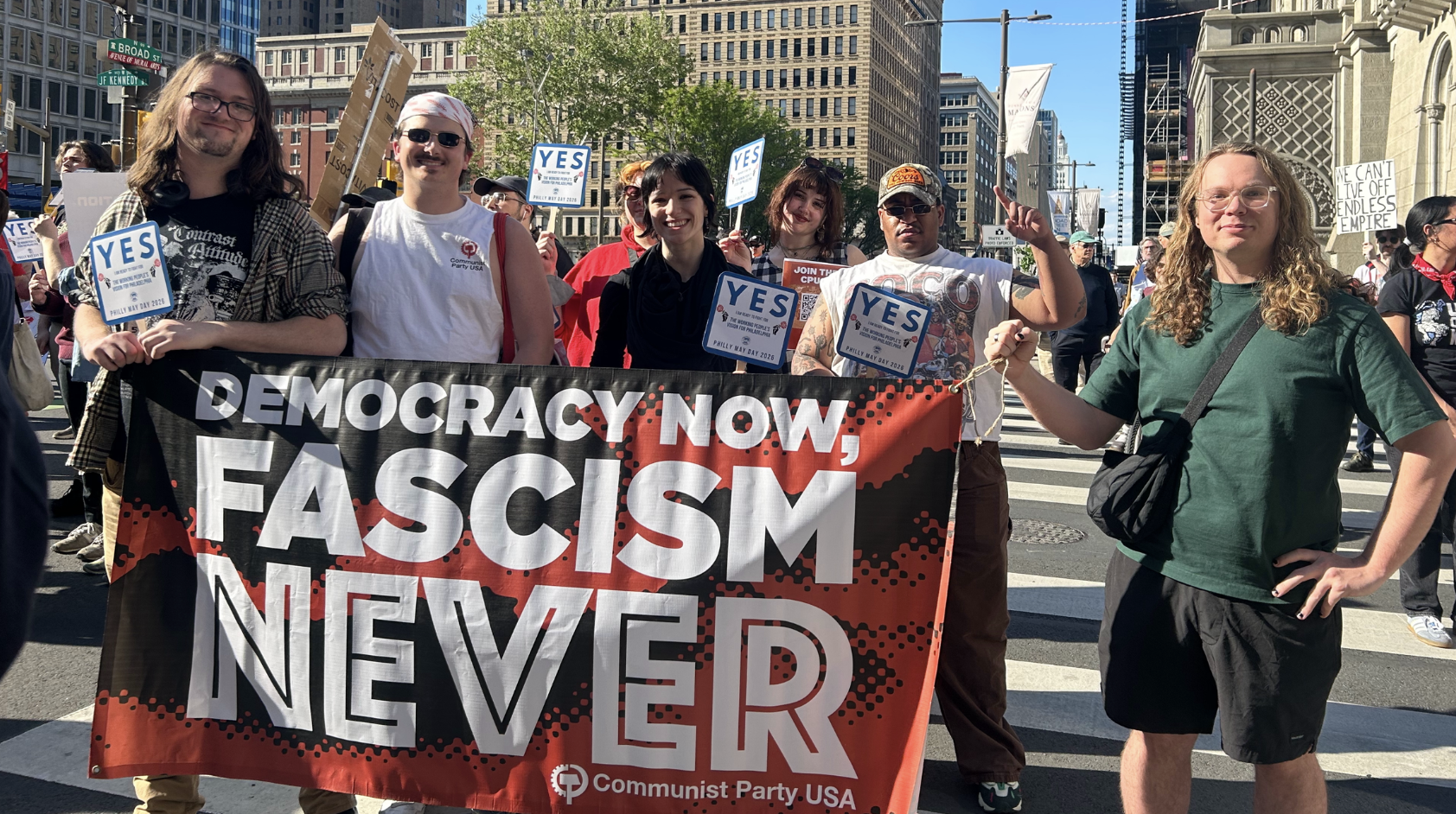
Adopted by the Debbie Amis-Bell Club (Philadelphia) of the Communist Party USA at its 2026 Club Conference.
America 250, the World Cup, MLB All-Star weekend, and other summer festivities have brought thousands of people here and this is exciting. Philly is a world class city that people all across the globe ought to visit and experience. However, the dichotomy between what is being spent on these events and what is being spent to better the lives of those of us who live here full time is stark.
Last year during the historic AFSCME DC33 municipal workers strike, Mayor Cherelle Parker told Philadelphians that she would, “not put the fiscal stability of the City of Philadelphia in jeopardy” to meet the demands of the union. Now just a year later, she’s putting on a Fourth of July concert that cost taxpayers over $15 million, at the same time the city is hosting the FIFA World Cup. This comes just days after it was reported that she allowed two city officials, Councilmember Curtis Jones and his wife City Representative Jazelle Jones, to pocket nearly $1 million by using a loophole in a retirement program offered to long term city workers. At the same time the average Philadelphian is facing school closures, climbing rent prices due to unchecked development, unaccountable police, unreliable public transportation and subpar wages.
With the 2027 Citywide primary elections around the corner and the recent wave of progressive electoral victories, our city is potentially on the precipice of real change. Everyday Philadelphians are in a position to make demands from local officials and shift the balance of forces away from the ultrarich who have bought off our politicians for far too long. In that vein, our club has developed a five point minimum program that can be used to mobilize our members and the broader working class movement ahead of next year’s primary and beyond, to address the most pressing issues facing our residents. These points are listed and detailed below.
The University of Pennsylvania Must Pay PILOTs
The University of Pennsylvania (U. Penn) is worth nearly $34 billion dollars, yet the city hardly benefits from that wealth, which they have accumulated since before our country’s existence. This is because the university claims nonprofit status, meaning they are not obligated to pay city property taxes. This withholds crucial funds for the School District of Philadelphia, which is currently experiencing a lack of funding crisis.
Of all the Ivy League institutions, U. Penn is the only one that does not pay PILOTs. Instead, they have offered a measly $10 million a year to the school district since 2020. When compared to what they are worth, what other universities pay and what is needed to fund our public schools, this figure simply will not cut it.
According to the Penn for PILOTs campaign, a fair payment amount would be 40% of what they would hypothetically have to pay in property taxes. This would be approximately $40 million, which is less than 1% of their unrestricted annual revenues and their endowment from 2021.
Philadelphian students and families deserve fairly funded public schools, with robust staff, adequate buildings and extracurricular activities. Therefore, the University of Pennsylvania must make meaningful contributions to our city and pay PILOTs.
Rent Increases Must Be Capped At 3% Per Year
Nearly half of the people who live in this city pay rent for their housing as opposed to owning their homes, as mortgage costs continue to increase. For renters, however, those monthly payments are still incredibly costly relative to how much working people are making in wages. In 2024, nearly half of renters in Philadelphia paid 35% or more of their paycheck on rent a month. Additionally, in that same year to afford the median rate in rent, it would require over $15,000 more than the median income.
Philadelphia needs more deeply affordable housing built around the city. However, allowing developers, institutions or sports teams unrestricted access to build wherever they want is one of the biggest sources for the housing crisis we’re seeing. We should not rely on the good will of profit driven entities, whose first priority is their bottom line, to deliver affordable housing. This is the responsibility of our elected officials.
Safe and affordable housing is not a privilege, it is a human right that must be guaranteed and protected. Working people of Philadelphia need rent-stabilized leases capped at a 3% increase per year and 90 days notice of rent increases over that 3%.
CPOC Must Have Independent Investigative Power
In 2020, nearly 80% of Philadelphia voters voted to create the Citizens Police Oversight Commission (CPOC). However, it is largely unable to fulfill its responsibility of holding police accountable. This is because of the Fraternal Order of the Police (FOP) contract with the city, which does not allow for CPOC to conduct investigations of misconduct independent of the Philly PD Internal Affairs Division.
Police misconduct cases number in the hundreds and cost taxpayers millions a year in payouts. However this hardly ever results in these officers permanently being removed. In fact, 85% of them are reinstated after arbitration. Even officers who engage in the worst kinds of misconduct, such as Mark Dial who murdered unarmed Eddie Irizarry, face little repercussions for their actions.
This system is not only unjust, but unsustainable. CPOC cannot remain toothless as city police officers are all but given the greenlight to engagement in harassment, brutality and murder. CPOC must have the ability to conduct independent investigations and have adequate funding to do so.
Public Transportation Must Remain Affordable and Accessible
The Philadelphia area public transportation system is facing a funding crisis. Last fall because of a $200 million plus deficit, SEPTA, the city’s transportation system, briefly cut critical services and eliminated routes. Governor Shapiro’s temporary solution of allowing SEPTA to use the state’s Department of Transportation funds reversed those cuts and eliminations, but is only allowable for two years.
Still, crumbling infrastructure, unreliable scheduling and rising fares leaves many people with no way to travel throughout the city to work, school, doctors appointments, the grocery store, etc. Right now, 25% of city communities rely on public transport. With no permanent or long term plan to not only fund SEPTA’s daily operations but revitalize and expand the transportation system, more people will be impacted and less people will use it to get around the city. Less riders means less money, and this will ultimately worsen the funding crisis.
Although a large part of public transportation funding falls on the state legislature, city officials must take some responsibility in keeping SEPTA running and accessible. Council Member Nicolas O’Rourke has recently championed the creation of the Transit Access Fund, which would set aside 0.5% of Philadelphia’s general fund for the Zero Fare Transit Program for low income Philadelphians along with other needs. This would ensure that SEPTA has a permanent stream of local funds and that access for those who are in the most need is guaranteed. We are calling on all city officials to support the creation of the Transit Access Fund and explore other permanent funding initiatives for public transportation.
The City’s Minimum Wage Must Be Raised
Nearly 20% of Philadelphians live below the federal poverty line. This is nearly double the national average and more than other major cities, such as Chicago, Boston and Washington D.C. Black and Latino residents are even more poverty stricken with the percentage of those living below the poverty rate at about 25% and 26% respectively. Additionally, Philadelphia has the highest percentage of people living in “deep poverty” at 10%. This means 157,000 Philadelphians live on a yearly income of $16,000 or less.
Stagnant and subpar wages are one of Philadelphia’s biggest crises. However, city officials alone can do little to solve it. This is due to the Pennsylvania Minimum Wage Act, which does not allow the city to set its own minimum wage. This undoubtedly contributes to the financial precarity many residents find themselves in. Not only does Philadelphia’s minimum wage lag behind neighboring major cities like New York City, Pennsylvania as a whole lags behind neighboring states. The state minimum wages in New Jersey, Delaware and New York are all above $15/hour.
Philadelphians should not have to wait until state legislators, who are not experiencing the poverty crisis in our city directly, to finally raise the state minimum wage. This is a crisis that necessitates consistent action and advocacy from local public servants who see it first hand. And while the bill that recently passed in the State House to raise the minimum wage to $15/hour by 2029 is a step in the right direction, there are two glaring issues. Firstly, the bill is unlikely to pass the GOP controlled State Senate. Secondly, a $15/hour minimum wage in 2029 is sure to be insufficient by then. The state’s minimum wage must be raised to $17/hour or the Pennsylvania Minimum Wage Act be amended to allow Philadelphia to set its own minimum wage to $17/hour.
The national trend of progressive and working class candidates being elected to political office has touched Philadelphia with Chris Rabb’s victory and it will undoubtedly continue into next year’s primary. However, this trend is not enough without progressive policies that uplift the working class being enacted alongside it. Our class deserves fairly funded education. We deserve stable housing and fair rent. We deserve fair, community controlled police accountability. We deserve fairly priced and funded public transit. We deserve fair wages and good union jobs. These demands aren’t idealist, impossible, or “pie in the sky”. They give Philadelphians a fair shot at a more prosperous life and more prosperous city.
The opinions of the author do not necessarily reflect the positions of the CPUSA.
Images: All images courtesy of the Debbie Amis-Bell Club, CPUSA. Communist Party USA.
Author

-
The Debbie Amis-Bell Club of the CPUSA Eastern Pennsylvania and Delaware District is based in Philadelphia, PA.
 Join Now