

In May, Trump’s Justice Department launched fraud charges against the Southern Poverty Law Center (SPLC), which had recruited individuals to investigate and expose the Ku Klux Klan and other racist, anti-Semitic groups, including Aryan Nations and the National Alliance, a continuation of the “American Nazi Party.”
The SPLC exposés and lawsuits against these groups since 1980 helped to discredit and bankrupt many of them. They worked with both Democratic and Republican administrations, state and local governments, and police forces.
But not with the Trump administration, which pardoned January 6 insurrectionists, including Proud Boys, Oath Keepers, and others involved in racist and terrorist organizations which the SPLC had exposed long before Trump’s failed January 6 coup.
Shortly before the Justice Department’s May indictments, Trump said on 60 Minutes, the CBS weekly news program, that the 2017 “Unite the Right” rally in Charlottesville, Virginia — which brought Klansmen and neo-Nazis together to defend a statue of Confederate General Robert E. Lee and resulted in the murder of a protester — had been “funded by the Southern Poverty Law Center” to discredit patriotic Americans. Trump infamously had said that there were good people on both the racist and the anti-racist sides.
Last week, the Justice Department arrested and indicted Heidi Beirich, the former chief financial officer of the SPLC, on charges of fraud, funding hate groups, money laundering, and having a romantic relationship with one of the paid informers. Attorney General Todd Blanche rejects the SPLC’s claim that this indictment is false — a contention supported by the NAACP, the American Civil Liberties Union (ACLU), and other civil rights and civil liberties groups.
The government attack on the SPLC is a kind of McCarthyism on steroids. Here nonprofit organizations, like the NAACP and the ACLU, can have their funding cut off and their officers potentially arrested and imprisoned. Civil rights, civil liberties, peace groups, and parties and organizations supporting socialist and national liberation movements globally, would be subject to attacks. It is likely that they will be defined, as the CPUSA and a wide variety of groups, as “communist front” groups under the McCarran Internal Security Act, and compelled to turn over their membership lists and financial records. If the refuse, their leaders could be subject to imprisonment.
What has the SPLC achieved that has led to these attacks
Morris Dees, a prominent civil rights attorney, founded the SPLC as a civil rights legal clinic in Montgomery, Alabama, in 1971. Julian Bond, a well-known civil rights leader, was its president.
In 1979, as racist violence intensified across the U.S., the SPLC began to expose, list, and launch lawsuits against racist groups. It also recruited and paid informants to infiltrate such groups. Its record of achievements was remarkable. Here is a short list of these achievements:
In 1980, following a summer of KKK violence in Alabama, the SPLC, in Brown v. Invisible Empire, Knights of the KKK, launched a suit against the Klan representing a Black woman who had been shot by a Klansman. The SPLC then established Klanwatch, through which it launched many successful suits against the KKK. The SPLC’s actions also led the FBI to revive its investigations of the KKK, which led to the arrest and conviction of Klansmen for many crimes, including murder. By 1990, the KKK had seen its membership drop and its funds greatly reduced.
In the 1980s, as the KKK splintered, groups within it formed what they called “patriot militias,” merging racism, anti-Semitism, xenophobia, and attacks on the government — which they called the “Zionist Occupied Government” (ZOG) — into the center of their activity. The SPLC sued and won major victories against neo-Nazi groups like White Aryan Resistance, the neo-Nazi “Church of the Creator,” and Aryan Nations, which greatly disrupted their activities and depleted their resources.
In 2007, the SPLC established Hatewatch, its major internet blog, posting accounts of racist and fascist organizations that highlighted Trump’s use of neo-Nazi memes before and during his run for president in 2016.
The SPLC has involved itself in successful suits to protect immigrant workers, including undocumented workers imprisoned by ICE. Its suits led to the elimination of chain gangs in Mississippi, the integration of Alabama State Troopers, the closing of private prisons with deplorable conditions, the ending of abuse of disabled and ill people, and opposition to the suppression of voting rights. It has worked with the ACLU, the NAACP, and other groups on many of these campaigns, and has helped bring these and other groups into the struggle.
It should be said that, like many militant organizations, the SPLC has a history of fierce internal conflicts and expulsions of leadership, which have been used by its enemies. It has seen its headquarters bombed and its leaders become the target of assassination plots. Although it is not a political party and is not in any way committed to socialism as America’s future, the Trump administration has targeted it the way the U.S. government targeted the CPUSA after 1947. It understood that if the CPUSA could be bankrupted and broken, the groups who had allied with it would fall back, and the united and people’s fronts which had led to the great working-class victories of the 1930s and 1940s would no longer exist.
What can and must be done
This situation today is different than it was in the 1950s — in some ways better and in other ways worse. First, it is worse in that the Supreme Court, which played a positive role eventually in opposing “McCarthyism,” is today under Trump’s control. The strategy then was to segregate and isolate the CPUSA. Today, Trump is seeking to search and destroy not only the left but all real and imagined opposition in order to establish a militarized police state.
But the situation is better in that there is massive opposition among the whole people to both Trump and his policies. In the 1950s, there was a Cold War-induced anti-communist consensus. Today, there is no such consensus.
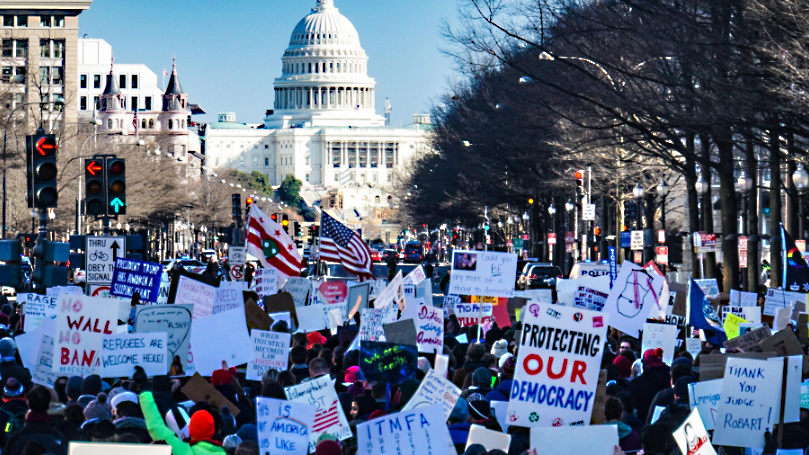
What must we do to create an anti-fascist consensus? First, we must engage in mass protests against Trump’s actions and be ready to fill the jails as the civil rights movement did in the 1960s to defeat a de facto racist dictatorship. We must build an inclusive People’s Front to advance that policy. And we must focus on the midterm elections to take Congress away from Trump and his “MAGA” fascist Republican Party. This is what is to be done. It can and must be done.
The opinions of the author do not necessarily reflect the positions of the CPUSA.
Image: Protecting our democracy by Harvard University. CC BY-SA 4.0.

 Join Now