The Communist Party, USA, has had a key role in the struggle for peace throughout its history. Its founding in 1919 was catalyzed by the shock of World War I, which caused levels of death and destruction that had never been seen before. Its long history of fighting for peace and justice is as relevant as ever in our times.
Marx, Lenin, and the struggle for peace
In fact, the struggle for peace has been central to communist thought from the beginning. In Karl Marx’s 1864 inaugural address to the International Workman’s Association, he put forward what remains the Marxist and Communist view of the struggle for peace; that is, a recognition that workers must struggle against capitalist nations’ foreign policies that destroy indigenous cultures through forced labor, formal slavery, and outright slaughter. He asks how workers can be free without international solidarity:
If the emancipation of the working classes requires their fraternal concurrence, how are they to fulfill that great mission with a foreign policy in pursuit of criminal designs, playing upon national prejudices, and squandering in piratical wars the people’s blood and treasure? … The working classes [have] the duty to master themselves the mysteries of international politics; to watch the diplomatic acts of their respective governments; to counteract them, if necessary, by all means in their power; when unable to prevent, to combine in simultaneous denunciations, and to vindicate the simple laws or morals and justice, which ought to govern the relations of private individuals, as the rules paramount of the intercourse of nations. … The fight for such a foreign policy forms part of the general struggle for the emancipation of the working classes.
The revolutionary faction of the Russian Social Democratic Labor party (Bolsheviks), led by Vladimir Lenin, opposed involvement in World War I, upholding the directive laid out by Marx. In contrast, most of the mass socialist parties at the beginning of the 1900s instead supported their governments once war was declared.
Marxist-Leninist thought is grounded in three theses that Lenin contributed to Marxist theory. First, Lenin called for a revolutionary vanguard party of advanced workers and revolutionary intellectuals organizing, educating, and coordinating the struggle of the working class.
Lenin’s second thesis was to create a new revolutionary workers’ state, not simply struggling to win elections in the existing state.
Third, he defined the “new” imperialism of monopoly capitalism, in which the imperialist powers seek to export capital to the colonial regions of the world, leading to the super-exploitation of the people in other regions of the world, and to ever more destructive wars like the first World War had been. These three theses became the foundation for the Communist parties of the world that were founded post-World War I. Lenin called for Communists to take on the struggle for the liberation of the people in these colonial regions and to combine the struggle for national liberation with the struggle for socialism.
Communists in the U.S. embraced Lenin’s analysis of imperialism and opposed the attacks against the Soviet Union carried out by capitalist nations through the 1920s.
The Party also fought for the rights of workers in the U.S. who had migrated here in the first half of the century. It organized against the Ku Klux Klan (KKK) during that organization’s powerful second period (1915-1944). Then as now, the KKK attacked immigrants, people of African descent, communists, labor organizers, Catholics and Jews. U.S. Communists joined with others to establish the International Labor Defense (ILD) in 1925 and the American Committee for the Protection of the Foreign Born in 1930. Mass organizations played an important though unsuccessful role in both national and global campaigns to save two immigrant Italian anarchists, Nicola Sacco and Bartolomeo Vanzetti, from being executed in 1927 for a crime they did not commit.
Anti-colonialism, anti-racism, and peace
Using the analytic tools from Marx, Lenin, and other early thinkers, Communists at that time defined people of African descent as an “internal colony.” Most Black folks then lived in the deep South in a region called “the Black Belt.” In 1935, Communists created the National Negro Congress, in the tradition of the anti-colonial Indian National Congress and African National Congress.
Important African American activists joined the CPUSA, including William L. Patterson, who had been part of the Sacco-Vanzetti defense campaign, and Harry Haywood, among others. Patterson would continue his work in both political and cultural campaigns, in shared struggle with his wife, Louise Thompson Patterson, and with Paul Robeson, the famed Black American actor, singer, and people’s artist.
Struggles for peace demand ending imperialist adventures outside the U.S. and state violence against the working class domestically.
For comrades in the CPUSA, the struggle for peace includes not only working to end imperialist exploitative adventures outside the U.S. but also the violence perpetrated against the working class, women and oppressed people, here in the United States. Three centuries of racist oppression were the subject of the book We Charge Genocide, presented by Patterson and Robeson to the United Nations in 1951. While the study was suppressed in the U.S. and Patterson was arrested and imprisoned under the Smith Act, We Charge Genocide was influential in awakening global opinion to U.S. racism and continues to be read and studied today.
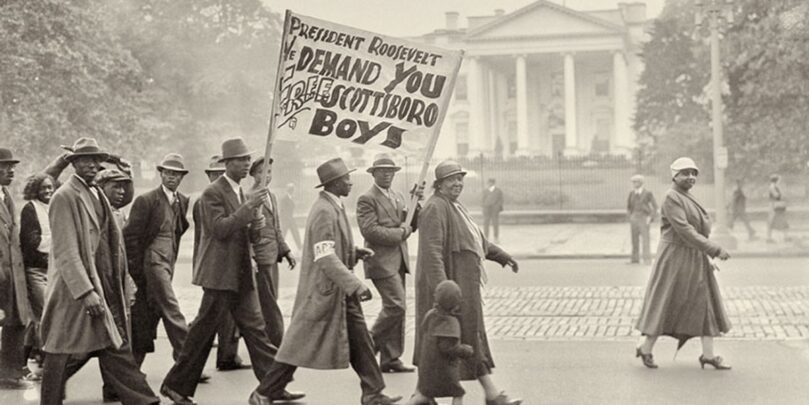
After his release from prison, William and Louise Thompson Patterson became the center of a new generation of Black intellectuals and artists in Harlem. They and other Black activists became involved in the movement, which would eventually save the lives of Scottsboro 9, radicalize both the NAACP and ACLU, and spark demonstrations in solidarity with the Scottsboro Nine throughout the world. This was the first time that the oppression of Black Americans received such global recognition since the global anti-slavery movement spread accounts of the Fugitive Slave Law in the U.S. before the Civil War.
For peace, against fascism
In the 1930s, the struggle for peace was the struggle against fascism. Communists worked with others to awaken the working class and the U.S. people to the fascist menace, organizing around the slogan “Against Fascism and War.” Communists organized against Japan’s colonizing of Chinese Manchuria with “Hands off China” demonstrations. When fascist Mussolini launched his brutal invasion of Ethiopia, Communists played a leading role in condemning the invasion and calling for boycotts of Italian goods. Communists also played a leading role in demonstrations against Nazi Germany’s campaign of extermination against communist, Jewish, Black, LGBTQ+, and Roma people, as well as trade unionists, socialists, and others. The Party filled Madison Square Garden in 1933 in one of the first and largest anti-Nazi rallies. Communists also brought attention to big business support for Hitler in the U.S. This included Ford Motors, Chase Manhattan Bank, Woolworth, Coca-Cola, and IBM. In 1935, Communist activists from the Seamen’s Union boarded the German ship, S.S. Bremen, in New York harbor and pulled down the Swastika as a cheering crowd on shore watched.
Harry Bridges, a close ally of the CPUSA and president of the International Longshoreman’s and Warehouseman’ Union (ILWU), acted to block the shipping of oil and war materials to the Japanese empire as it fought a full-scale undeclared war against China.
The CPUSA actively exposed the Hitler regime’s brutal and escalating fascist oppression of workers and ethnic and national minorities, along with German Communists, who were among the first imprisoned in concentration camps and the first who gave their lives in the struggle against Hitler fascism. The CPUSA called for boycotts of German goods and led campaigns against local fascist organizations like the German American Bund, Father Coughlin’s Christian Front, and Rev. Gerald L.K. Smith. During World War II, Smith, a Hitler imitator and rabid anti-Semite, sought to form a party called the America First party with its publication “The Cross and the Flag. Today the Trump administration’s use of the America First slogan, incitement of white supremacy and “Christian nationalism,” has revived much of what Smith stood for.
The anti-fascist fight required defensive war
In the struggle against fascism, the fight for peace also meant going to war to defend against fascist militarism. When General Francisco Franco, with the support of Mussolini and Hitler, launched a violent coup against the elected People’s Front government of Spain, the major capitalist states refused to provide any aid to the Spanish Republic, preferring a fascist Spain allied to Hitler and Mussolini over a socialist-oriented government supported by the Soviet Union, the only nation which aided the Republic.
Communists throughout the world played the leading role in mobilizing over 40,000 volunteer troops in brigades to fight for the Republic, including the U.S. Abraham Lincoln Brigade. While fascism established itself in power in Spain, many of the international volunteers who fought for the Republic would distinguish themselves in resistance movements during World War II, as did Abraham Lincoln Brigade members.
As Martin Luther King Jr. remarked, “Peace is not merely the absence of war but the presence of justice.”
As Martin Luther King Jr. remarked, “Peace is not merely the absence of war but the presence of justice.” U.S. Communists continued to connect the struggle for peace with the struggle against racism, joining with civil rights groups to call for a “war against Hitler abroad and Jim Crow at home.” CPUSA also actively supported the New Deal government’s Win-the-War coalition and fought to launch an early second front in Europe, which would have saved millions of lives and hastened the end of the war.
The Party supported President Franklin D. Roosevelt’s call to build the United Nations (U.N.) into a force both to maintain world peace and, through its agencies, to advance economic reconstruction and reduce poverty and inequality throughout the world. These basic goals have recently been disavowed by Donald Trump, whose speech to the U.N. General Assembly in late September denounced the U.N. itself.
Post-WWII peace struggles, and against the “Cold War”
The Communist Party continued the fight for peace when President Truman returned to the anti-Communist and anti-Soviet policies that had led to the rise of fascism and the second World War. Truman used the atomic bomb to gain U.S. global hegemony, killing hundreds of thousands of innocent civilians. Truman supported anti-Communist governments in the Chinese and Greek civil wars against Communist-led insurgents and committed the U.S. to opposing the Soviet Union and all revolutionary people’s movements, a policy known as the Truman Doctrine. Truman established the North Atlantic Treaty organization (NATO) to prevent Communist parties from coming to power in Europe and to “contain” the Soviet Union.
At the same time the Truman administration worked against movements for peace at home. His administration’s House Un-American Activities Committee launched purges of real and alleged Communist activists in government, public jobs, and the arts, sciences, and professions, arresting the leadership of the CPUSA, subjecting them to sham trials, and imprisoning them under the Smith Act.
Truman’s cold war policies led U.S. Communists to face relentless persecution, which only redoubled the Party’s commitments to socialism and peace and to its democratic centralist organizational structure. Its deep roots in the working class enabled it to survive. Throughout these attacks, Communist activists continued to campaign for disarmament, for support for the U.N., and for recognition of the People’s Republic of China after the triumphant Chinese revolution. Communists engaged in active opposition to the U.S. intervention in the Korean civil war. In 1950, Communists campaigned for the World Peace Council’s “Stockholm Appeal,” signed by 273,470,566 million people, which called for the abolition of nuclear weapons.
During the U.S.’s Cold War with the Soviet Union, the CPUSA continued its peace campaign in the face of expanding arrests of Party activists, suppression of peace demonstrations, and new legislation targeting peace, civil rights and civil liberties groups “influenced” by the Communists. The Party established an Emergency Civil Liberties Committee when the ACLU refused to defend the rights of those under attack. When Senator Joseph McCarthy transformed the fears generated by the Truman administration’s cold war policies into national hysteria, the CPUSA mobilized international opposition to McCarthy’s reign of terror. McCarthy even turned the tables on the Truman administration itself by accusing the administration and the Democratic Party as a whole of being infiltrated and controlled by Soviet-directed Communist spies.
As the CPUSA and other progressive groups slowly regained their civil rights thanks to persistent struggle and some favorable Supreme Court decisions, opposition by the ruling class went under cover. The FBI launched its Counterintelligence (Cointelpro) program, continuing its criminal acts against the CPUSA and others. Acts against the CPUSA included wiretapping, burglarizing offices, going into neighborhoods where Party members lived to incite neighbors against them, and spreading lies accusing Jewish members of racism and Black members of anti-Semitism, attempting to create internal conflicts in the Party.
Countering the nuclear threat, demanding peace in Vietnam
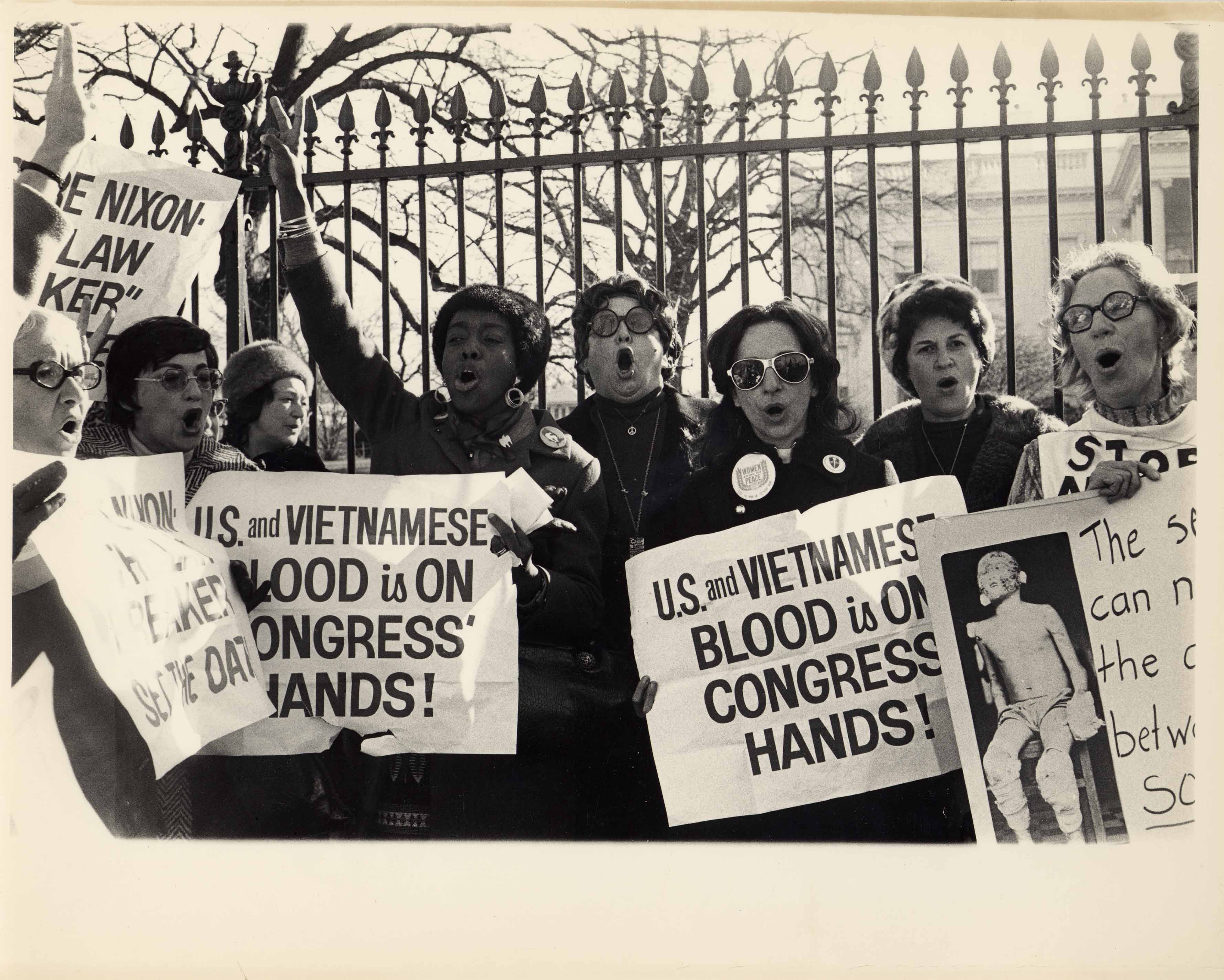
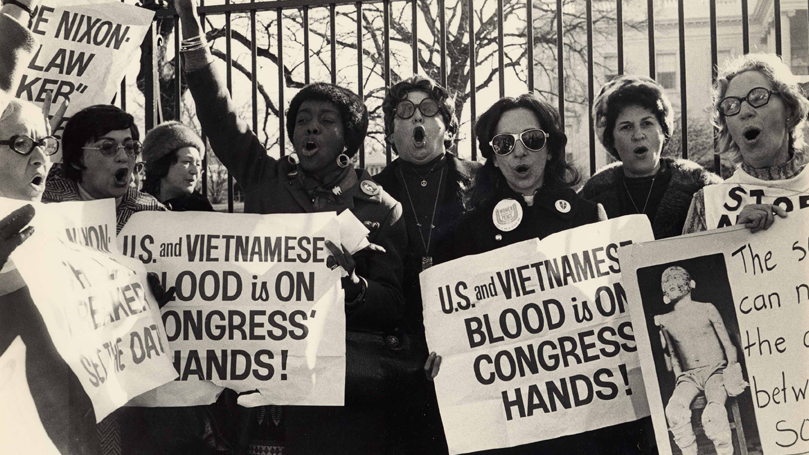
Communists and their allies continued to fight for peace. In 1961, the Party helped to establish the Women’s Strike for Peace, which organized demonstrations against nuclear weapons testing and was one of the earliest voices against U.S. involvement in Vietnam. The Party went on to play a key role in the mass anti-war movement, maintaining close relations with the Vietnam Workers Party, Vietnam’s Communist Party. Communist activists played a key role in demonstrations to block trains and ports transporting troops for Vietnam and in demonstrations. Communists played a significant role in both the Students for a Democratic Society (SDS) and the Student Non-Violent Coordinating Committee (SNCC) opposing both opportunist and “new left” anarchist tendencies and focusing the struggle on building a mass movement that challenged the war and the draft which discriminated against working class and especially minority youth. In June 1966, three draftees sent to Fort Hood Texas, repudiated U.S. involvement in the war as racist and imperialist. They were court-martialed and given long prison sentences. Two members of the Fort Hood Three, Dennis Mora, of Puerto Rican background, and James Johnson of African American background were and continued to be active CPUSA members. The case helped to highlight and increase opposition to the war among draftees.
Party leaders Gus Hall and Jarvis Tyner were in Hanoi during Nixon’s infamous Christmas bombing of Hanoi.
As the end of direct U.S. involvement neared, Party leaders Gus Hall and Jarvis Tyner were in Hanoi meeting with Vietnamese party leaders during Nixon’s infamous Christmas bombing of Hanoi, the most devastating raid of the war.
While the larger peace movement was becoming involved in opposition to the U.S. intervention and escalation of its imperialist war against the people of Vietnam, the Johnson administration sent U.S. troops into the Dominican Republic to oust those forces who sought to restore the democratically elected President, Juan Bosch, ousted in a coup supported by U.S. corporations and President Lyndon B. Johnson, who sent 22,000 troops. The CPUSA actively opposed this coup, which represented the first direct U.S. military intervention since President Franklin Roosevelt in effect repealed the Platt Amendment, established after the Spanish American War, which gave the U.S. the “right” to send troops into Cuba to “protect Cuban independence” whenever it wanted. This policy was then expanded to include much of Latin America. Of course U.S corporations with the support of the U.S. government continued to work behind the scenes to advance its interests in Latin America; the CIA used surrogate forces in a number of coups since the end of WWII. The CPUSA also was one of the very few peace groups to call for Israel to withdraw from the Palestinian territories it had seized in its victorious 1967 “six day war” and return to the 1949 U.N. resolution to both establish and co-exist with a Palestinian state, none of which has ever been honored.
International struggles for peace
Through the entire post-WWII period, the CPUSA actively supported the World Peace Council, established in 1949 by socialist countries and Communist parties under the leadership of the Soviet Union, using accounts of its campaign for nuclear disarmament, its defense of the Cuban revolution, and exposé of neo-colonial and imperialist crimes in Africa and Asia. The CPUSA also sent delegations to World Peace Council conferences and World Youth Festivals sponsored by the World Peace Council, behind the slogan “For Peace, Anti-Imperialist Solidarity, and Friendship.” The CPUSA also worked with the World Federation of Democratic Youth (WFDY), participating in their festivals.
After the end of the Vietnam War and the downfall of Richard Nixon, economies of “stagflation”(stagnation in terms of growth combined with inflated prices) became dominant. The U.S. government launched austerity policies which strengthened the far right and caused suffering in the working classes around the world. The CPUSA protested the Cold War policies of the day, like the Carter administration’s support for Afghan “freedom fighters” against the Soviet-supported Communist-led government of Afghanistan, and his grain embargo against the Soviets. The CPUSA also actively opposed the South African apartheid government, and the de facto U.S.-South African alliance to destroy the socialist oriented MPLA government in Angola, which came to power after the Portuguese colonial regime ended in 1975. The CPUSA also condemned the U.S. Southern African murderous interventions in Mozambique and Guinea Bissau and praised Cuba’s central role in supporting the MPLA government in both economic and military terms. Communists also compared Cuba’s role with that of the U.S., remembering that both had been major slave states before the abolition of slavery in the U.S. and the end of Spanish colonial rule in Cuba.
The CPUSA also joined with other peace groups to demand that the Carter administration establish full relations with the revolutionary Sandinista government in Nicaragua, which had overthrown the 44-year Somoza family dictatorship.
The deepening economic crisis and Carter’s domestic and foreign policy failures led to Ronald Reagan gaining the presidency. Referring to the Soviet Union as “the Evil Empire,” Reagan launched policies to expand weapons of mass destruction, calling for the development of thousands of mobile, nuclear capable missiles (cruise missiles) which could be placed on ships and moved from place to place as attack weapons.
Communists played an important role in emphasizing the enormous dangers that this policy represented, given the fact that both the U.S. and the Soviet Union had nuclear “overkill” capacity (meaning that they possessed nuclear armaments that, if they were all used, could theoretically wipe out humanity a number of times over. Communists then played a significant role, as a part of United for Peace and Justice (UFPJ), in mobilizing the June 12, 1982, New York peace march from Central Park to the United Nations. Over one million people participated in the march, which called for nuclear disarmament and was the largest political march in U.S. history.
Reagan expands U.S. support for international fascism
In response to the march and the peace movement, the Reagan administration came forward with its so called “strategic defense initiative” which it called Star Wars; an electronic shield that would stop nuclear missiles and serve, he claimed, as the basis for nuclear disarmament. Communists joined a much larger peace movement in seeing this plan as putting the U.S. in a position to launch a nuclear first strike. This policy was abandoned both because of its dangers and its lack of feasibility.
Reagan expanded U.S. funding and support for the Afghan fascist “freedom fighters” who would eventually become the Taliban and Al Qaeda. Reagan’s government armed and supported reactionary supporters of the former Somoza dictatorship, whom the Sandinista Government called “contras” (meaning counterrevolutionaries). The U.S. launched a military invasion against Grenada, a tiny former British colony in the West Indies whose new revolutionary government had been influenced by the U.S. civil rights movement. Communists joined with other groups in protesting most of these actions, but because of the prevalence of anti-Soviet and anti-communist propaganda, the CPUSA was alone in exposing the brutal CIA funded war against Afghanistan.
Communists have continued to be at the forefront of every struggle for peace since, protesting the first Bush administration’s invasion of Panama and the first “Gulf War” against Saddam Hussein’s Iraq. The U.S. encouraged Kurds and Shia Muslims to rebel against Hussein, but then abandoned them to be massacred. The CPUSA called continuously for sharp reductions in the military budget and the transfer of funds to social programs. It called for the dissolution of NATO and later opposed its expansion into Eastern Europe.
The CPUSA condemned and mobilized against the police state policies of the G.W. Bush administration in the aftermath of the 9/11 attack, which Communists rightly saw as a direct result of U.S. support for Al Qaeda and the Taliban in the 1980s. These policies included Bush‘s second gulf war against Iraq, which occupied Iraq with the aid of private contractors and turned it into an ongoing war zone. The CPUSA also helped build opposition to the Bush administration’s use of the U.S. base at Guantanamo Bay, Cuba, as a political prison, and policies which led to massive harassment and discrimination against Muslim Americans.
The need to break with neoliberal policies
Communists looked positively at Barack Obama’s election and supported his improvement of relations with Cuba and other positive policies. Continued economic stagnation, Obama’s failure to break with neoliberal economic policies, and intensified racism eventually limited his achievements and led to the election of Donald Trump, who embraced neofascism to oppose both neoliberalism and all progressive and democratic movements and policies.
Communists actively campaigned against the first Trump administration, supporting the call for his impeachment, and opposing his imperialist policies toward Venezuela, China, and other nations.
Communists actively opposed the Biden administration’s continued active support for NATO expansion, refusal to follow up on Obama’s improvement of relations with Cuba, and most of all failure to prosecute Trump for his unsuccessful January 6, 2021, coup to deny his election defeat and regain power.
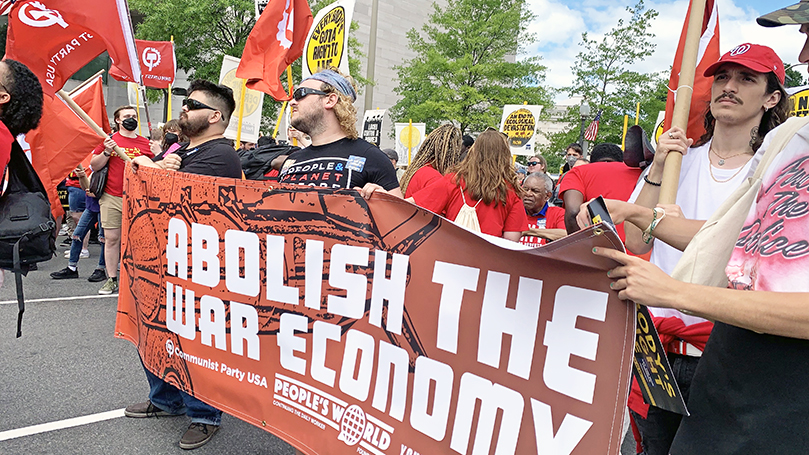
Today the CPUSA continues to campaign with groups throughout the U.S. for a ceasefire in the Israel-Hamas war, against Israel’s genocide against the people of Gaza, and for the establishment and recognition of a Palestinian state, which the United Nations has called for since 1948. The CPUSA has actively campaigned against the Biden and Trump administration’s refusal to support any of these policies.
The CPUSA today also condemns the Trump administration’s threat to revive nuclear testing, its military threat and destructive economic war against the People’s Republic of China, and its extra-judicial murder of over a hundred seamen on Venezuelan ships, under the pretext that these ships were running drugs to the U.S. The CPUSA has condemned in all of its media the kidnapping of Nicolás Maduro, President of the Bolivarian Socialist government. The planned seizure of Venezuelan oil by the Trump administration is a return to the sort of gun boat diplomacy that made the U.S. feared and hated throughout Latin America in the first decades of the 20th century. Finally, Trump’s campaign to annex Greenland has received universal condemnation, both from socialist countries and the major capitalist countries of the NATO bloc.
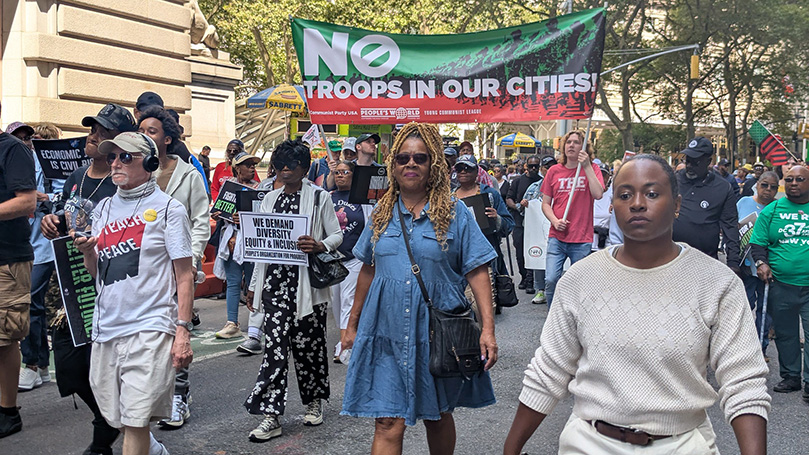
Today, as the Communist Party USA’s November 2025 Peace Conference 2.0 made clear, the issues of war and state violence animate activism in many distinct parts of the people’s democratic movement, from labor rights to the global climate crisis, and the rights of people of color, women, immigrants, and youth. Communists bring the Communist Plus to these movements and recognize the existential imperative to demilitarize our nation. As long as U.S. imperialism’s policy continues to embrace the big lie, “perpetual war for perpetual peace,” the Communist Party will continue its century-old struggle for peace as part of the struggle for socialism, environmental and social justice.
The opinions of the author do not necessarily reflect the positions of the CPUSA.
Images: CPUSA. Creative commons. March for Scottsboro Nine. CPUSA archives. Censure Nixon Rally, Women Strike for Peace January 18, 1972 by Swarthmore College Peace Collection. Public domain. Abolish the war economy. CPUSA. Creative Commons.

 Join Now