

Contribution to the CPUSA’s Peace Conference 2.0: Driven by Justice — United for Peace, Nov. 8, 2025.
The other day I was talking with my younger brother. He’s in academia — a tough position to be in right now, especially under this administration — and I’m a senior in undergrad trying to find a job. We were both venting about how things are. There was a lot of hopelessness in that conversation: neither of us felt good about the way things are going, about our prospects, or about the world in general.
We aren’t alone in that feeling. It’s a very common sentiment among young people today. We’re a deeply interconnected generation, and we’re also deeply anxious. It’s not hard to see why: economically, we face a terrible job market and crushing student debt. At the same time, there’s a deliberate shredding of our social safety nets — healthcare, education, housing — that makes it hard to even imagine growing up and having a stable home.
Our civil rights are constantly under attack by a reactionary, regressive MAGA movement. For many of us, this is deeply personal. My parents are immigrants, so my family feels the threat of rising fascism intimately — the anti-immigrant hatred, the terrifying actions of ICE that terrorize our communities.
And overshadowing everything is the war machine. The federal budget is, in essence, a war budget. We see our future — our schools, clinics, jobs — converted into bombs and overseas bases used to terrorize other communities and funnel profits to a militarist, capitalist, imperialist class.
To be blunt: young people don’t want to die in a war for oil or empire. We know the people making these decisions are older, and their children won’t see the frontlines. We will — and it will disproportionately be the most vulnerable: Black and Brown communities drafted first into these conflicts. The children of Congress won’t be on those frontlines.
The result of all this is a pervasive sense of nihilism. It’s not that we don’t care; it’s a feeling of powerlessness against a system that funds death over life, over and over again.
So the question becomes: how do we turn this disillusionment into power and action?
I think we start by naming the connection. Opposition to war isn’t abstract: there’s a direct line between a fully funded Pentagon and our defunded community colleges, between bombs and skyrocketing tuition. War is a disaster for the working class here and everywhere. This is a material issue for young people.
We also have to merge our movements. Throughout history, young people have been on the frontlines of peace movements — from Vietnam to the recent college encampments for Palestine. But our power multiplies when we stand shoulder-to-shoulder with organized labor. Now is the best time to do it. We’re a hyper-connected generation. Our phones and the internet can fuel anxiety and doomscrolling, but they’re also powerful tools for organizing. We can expose the truth, coordinate action, and build solidarity across cities and campuses.
Imagine the strength of a coalition where student debt strikers use that digital power to stand with teachers on strike, or where young climate activists walk the picket line with autoworkers. This is the multi-ethnic, multi-racial, multi-gender united front we must build.
And in this party, we have a deep history of exactly that. The CPUSA has proudly fought for peace for decades — from fighting fascism in the ’30s and ’40s to organizing mass protests against the Vietnam War. We aren’t starting from scratch. We are the next chapter in a long and necessary struggle. We must study that history, learn its lessons, and adapt its tactics for our moment.
Our moment demands that we offer something affirmative — a vision of what we’re fighting for. We’re fighting for an equitable peacetime society; for a democratic, multilateral world that meets human needs, not corporate greed; for a future built on peace, solidarity, and respect for this planet. We’re offering something concrete that young people can see as a different future — something far from grim.
Sometimes it’s easy to forget that, especially growing up in times like these. I was talking with my youngest sister recently, and I mentioned how grim everything felt. I said, “I’m sure it feels grim for you too. It can feel hopeless. If you want to talk about it, you can.” She replied, “Yeah, but I think a lot of people my age are growing up fast. We also see a lot of people fighting back against all this. And that gives us hope.”
I think that’s crucial for us here today. We must not only continue the work so young people can draw inspiration from our shared struggles, but also create spaces where they are welcomed, where their issues are heard and cared for, and where they have the room and opportunity to grow and lead.
The opinions of the author do not necessarily reflect the positions of the CPUSA.
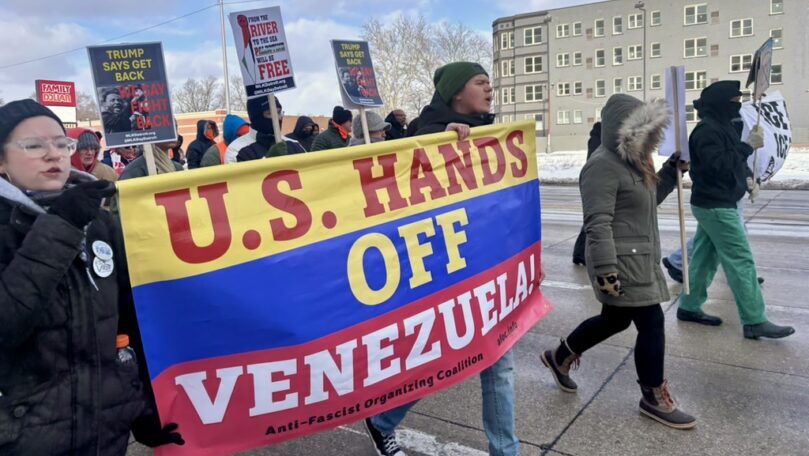
Image: CPUSA members march in Detroit for MLK Day, 2026.

 Join Now