

Artificial Intelligence (AI) is having a significant effect on employment law because it changes how employers recruit, hire, evaluate, manage, discipline, compensate, and terminate employees.
AI will potentially invade what is commonly referred to as Title VII protected class rights, i.e., race, color, religion, sex, and national origin, and let us not forget those federally protected rights afforded the disabled and elderly. For example, suppose an employer’s AI recruiting system learns from 10 years of hiring decisions. Now let’s suppose those historical decisions disproportionately favored men. AI may learn to favor male applicants. Thus, even without an instruction to discriminate, the resulting system could create a disparate impact.
Disparate impact refers to a practice, rule, or policy that looks neutral on the surface, but disproportionately harms a legally protected group. Unlike intentional discrimination, known as disparate treatment, disparate impact does not require proof that an employer, landlord, or institution meant to discriminate. Rather, it focuses entirely on the negative, unequal outcome.
So, who is responsible when an algorithm produces a discriminatory employment decision? The employer cannot simply blame the algorithm or software vendor. AI creates a new problem with neutral employment decisions because traditional discrimination law often examines the decision-maker’s conduct. AI complicates this because the employer may contend it did not discriminate because the algorithm selected the candidate. However, an algorithm can discriminate without having the intent to discriminate. This is what makes the disparate-impact doctrine especially important. With that, the employer may need to demonstrate what the AI system was designed to measure and variables it used. Whether those variables correlate with protected characteristics and whether the system has been validated. Did the AI system utilize alternative selection methods? Another important factor is to examine whether the system produces statistically significant disparities, and whether humans reviewed the AI’s recommendation.
AI and the Americans with Disabilities Act (ADA)
When it comes to people with disabilities, AI presents particularly difficult issues. For example, the AI hiring system might evaluate speech patterns, facial expressions, eye contact, typing speed, reaction time, personality characteristics, or responses to video interview questions. All of these can potentially be affected by a disability, and the result could be discrimination even though the employer never asked: “Does this person have a disability?” The ADA therefore creates substantial concerns about AI-based applicant screening and employee evaluation.
AI and employee surveillance
As we know, employers are increasingly using AI to monitor emails, computer activity, keystrokes, productivity, workplace conversations, and GPS location. This creates a collision between employer managerial rights and employee privacy rights. The United States currently does not have one comprehensive federal employee privacy statute comparable to the General Data Protection Regulation (GDPR) framework in Europe. Thus, employers must navigate a myriad of federal statutes, state privacy laws, electronic and communication laws, common-law privacy, and collective bargaining agreements.
AI, the National Labor Relations Act, Wage and hour laws
It is difficult to ignore that AI is becoming a labor-law issue and raises serious concern when it pertains to the right to organize. Section 7 of the National Labor Relations Act (NLRA) guarantees private-sector employees the core right to organize, form, or join labor unions, bargain collectively, and engage in other protected concerted activities for mutual aid or protection. This presents an important issue: whether employers have an obligation to bargain with unions before implementing AI systems that materially change employees’ working conditions. More specifically, will employers bargain in good faith before rolling out AI tools that alter mandatory workplace subjects like wages, hours, and daily working conditions?
If an AI tool changes how workers do their tasks, shifts their hours, or affects job safety, the employer is required to talk to the union first. Even if the employer’s choice to buy software is allowed, they still must bargain with the union over how the software affects the workers. A University of Chicago Law Review online essay by Austin Smith, titled NLRA Protections for AI-Driven Layoffs? describes in detail how unions like the Culinary Union secure these rights.
Another example is if an employer intends to implement an AI tool to watch workers, measure performance, or set quotas, prior negotiation is required. Introducing automation that leads to fewer hours or job cuts triggers the duty to bargain over these effects or decisions. AI scheduling creates interesting problems under the Fair Labor Standards Act (FLSA) and state wage laws. For example, an algorithm might schedule employees in a way that creates unpaid preparation time, discourages employees from recording overtime, produces off-the-clock work, automatically sends work-related communications outside scheduled hours, or misclassifies workers.
It is vital that employers do not lose sight of the fact that technology does not change their underlying legal obligation. An employer remains responsible for complying with wage and hour laws even when an algorithm administers the workplace.
AI and employee discipline
Now let’s imagine an employer’s AI system determines that an employee has a “high probability of misconduct.” From solely this determination, the employer terminates the employee. Naturally the employee wants to know why they were fired, and the employer’s response is that the algorithm identified them as a high-risk employee. This creates serious legal and practical problems. Employees in these situations will need to know what conduct led to their termination, what evidence was considered, whether the information or evidence was accurate, whether the employee had an opportunity to respond, and finally, whether protected characteristics influenced the decision to terminate. And if the AI information was wrong, this information is important.
One of the biggest challenges will be the inability to explain some AI decisions. Imagine an algorithm rejects an applicant. The employer may know the result but not be able to explain the reason why the algorithm reached a no-hire decision. This could create conflict with well-established employment law concepts such as adverse employment actions, legitimate nondiscriminatory reasons, insufficient documentation, evidentiary burdens, employee notice, and judicial review. In a litigation scenario, the employee’s attorney is likely to ask for training data, prompts, weighting systems, validation studies, audit results, vendor contracts and records of human review.
The employer’s use of outside vendors presents an important issue regarding deniability. We can anticipate employers will argue that because the AI system was developed by a third-party vendor, it is responsible. This tactic is unlikely to eliminate the employer’s legal obligations under employment law, but it does create emerging allocation of risk problems.
New state and local AI laws
Aside from the federal government as a source of regulation, states and municipalities are beginning to regulate automated employment decision-making tools. This is critical because an employer operating nationwide may have to comply with different AI employment rules in different jurisdictions. The most consequential development of AI in the workplace is that employment law is moving from regulating only human decision makers toward regulating those systems through which employment decisions are made. Traditional employment law asks, “Did the employer discriminate?” But in the AI era, employment law asks, “What system did the employer use to make the decision, what data trained it, was the system validated, did it produce discriminatory outcomes, and did the employer exercise meaningful oversight?” Who bears responsibility — the employer, employee, vendor or some combination?
It is not unreasonable to assume that by the time of this article being posted, AI will have penetrated deeper into the workplace and will continue at alarming speeds. AI’s impact on the workplace is creating legal issues the law cannot seemingly keep up with.
The opinions of the author do not necessarily reflect the positions of the CPUSA.
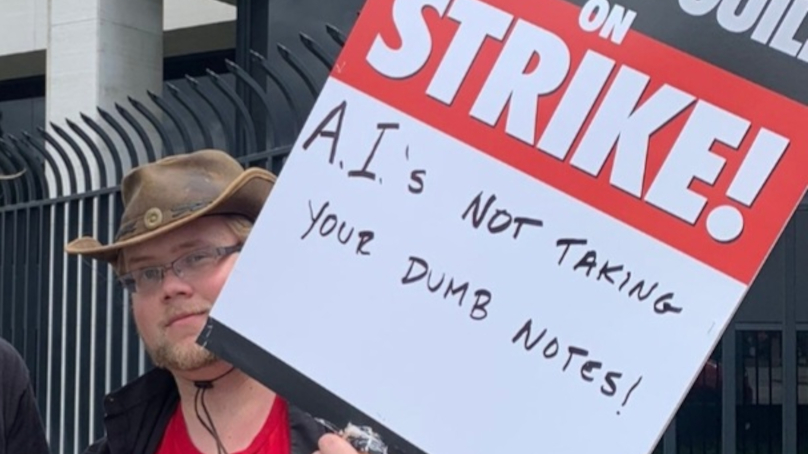
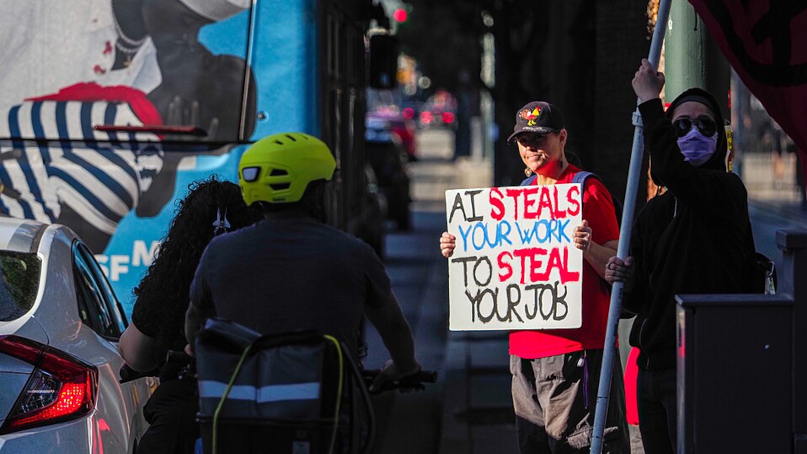
Image: AI is not taking your notes by David James Henry. CC BY-SA 4.0. Stop AI protest sf 2025-09-26 010 by Anderseidesvik. CC BY-SA 4.0.
Author

Patrick N. Chapin is a retired litigator, trial attorney, and ordained Buddhist Priest in the Navayana tradition.
 Join Now