

What does it mean to live a moral life under capitalism? And is that even possible? A friend of mine asked me that recently, and I got to thinking about it more deeply. As working people, we are constantly moralized at by the mouthpieces of the ruling class: by mainstream TV news, by the editorial boards of the legacy newspapers, and by the billionaire-backed politicians who lecture us about “working harder,” “personal responsibility,” and “financial discipline.”
As we rapidly approach the midterms, surely that moralizing will only intensify, and frankly, it already has. Yet these same voices, making excuses for a deeply unpopular status quo, have little to say about the criminal war on Iran that is driving up the prices of just about everything, about the monopolies free to price-gouge workers on everything from groceries to gas, or about a political system that serves only the wealthy while working families struggle to survive or even exercise our most basic right to vote.
I recently came across a short book called Marxist Ethics: A Short Exposition, published by International Publishers. What I learned reading that little book on the train home was that the study of Marxist ethics is actually extremely timely and necessary. It is not something typically discussed in our day-to-day organizing work, yet these questions of morality surround us as we seek to engage with the world and ultimately change it.
At its most basic level, Marxist ethics does not accept moral claims at face value. It asks where they come from, whose interests they serve, and what conditions produced them. Ethics is not something handed down from the heavens. It is a product of human society that is shaped by social relations and class conflict. And it demands a critical, practical approach not just to morality, but to society as a whole.

Bourgeois morality
Bourgeois ethics, on the other hand, is built around atomized individualism, much like the capitalist system itself. It treats society as a collection of independent actors, each pursuing their own interests, isolated from one another yet drawn into relationships via competition. In the realm of ideas, it emphasizes what are called negative freedoms, meaning freedom from external constraints, such as “freedom from government interference” or “freedom to choose.”
Under feudalism, the lords controlled the land and extracted rent, dues, and labor from the peasantry. The guilds, operating under the lord’s jurisdiction, regulated production and prices.. The Church, serving the aristocracy, condemned usury (loan-sharking) and the accumulation of obscene wealth by others. The idea that an individual could freely pursue their own economic interest, unconstrained by guild regulations or religious prohibitions, would have been morally incomprehensible to the ruling class whose power rested on exactly those constraints.
The rise of free trade and the merchant class eventually broke the feudal system open and ushered in the era of capitalism. Under feudalism the guilds and the state set limits on who could produce, at what price, for which market. Free trade tore those limits down and presented the result as some kind of “universal freedom.” The freedom it actually established was the freedom of capital to buy cheap and sell high, to expand itself across the world in search of raw materials and labor, and to move goods and money wherever profit was greatest.
As Marx and Engels said in The Communist Manifesto, the bourgeoisie “has pitilessly torn asunder the motley feudal ties that bound man to his ‘natural superiors,’ and has left remaining no other nexus between man and man than naked self-interest, than callous ‘cash payment.’”
After the bourgeois revolutions, a new moral order was constructed around the “free” individual who sells their products, or their labor power, in the marketplace. This is the historical origin of the “negative freedom” that the ruling class still celebrates today. According to its logic, the individual is “free” precisely in the sense that they are unconstrained by feudal obligations. But this “freedom” is merely abstract and formal upon inspection.
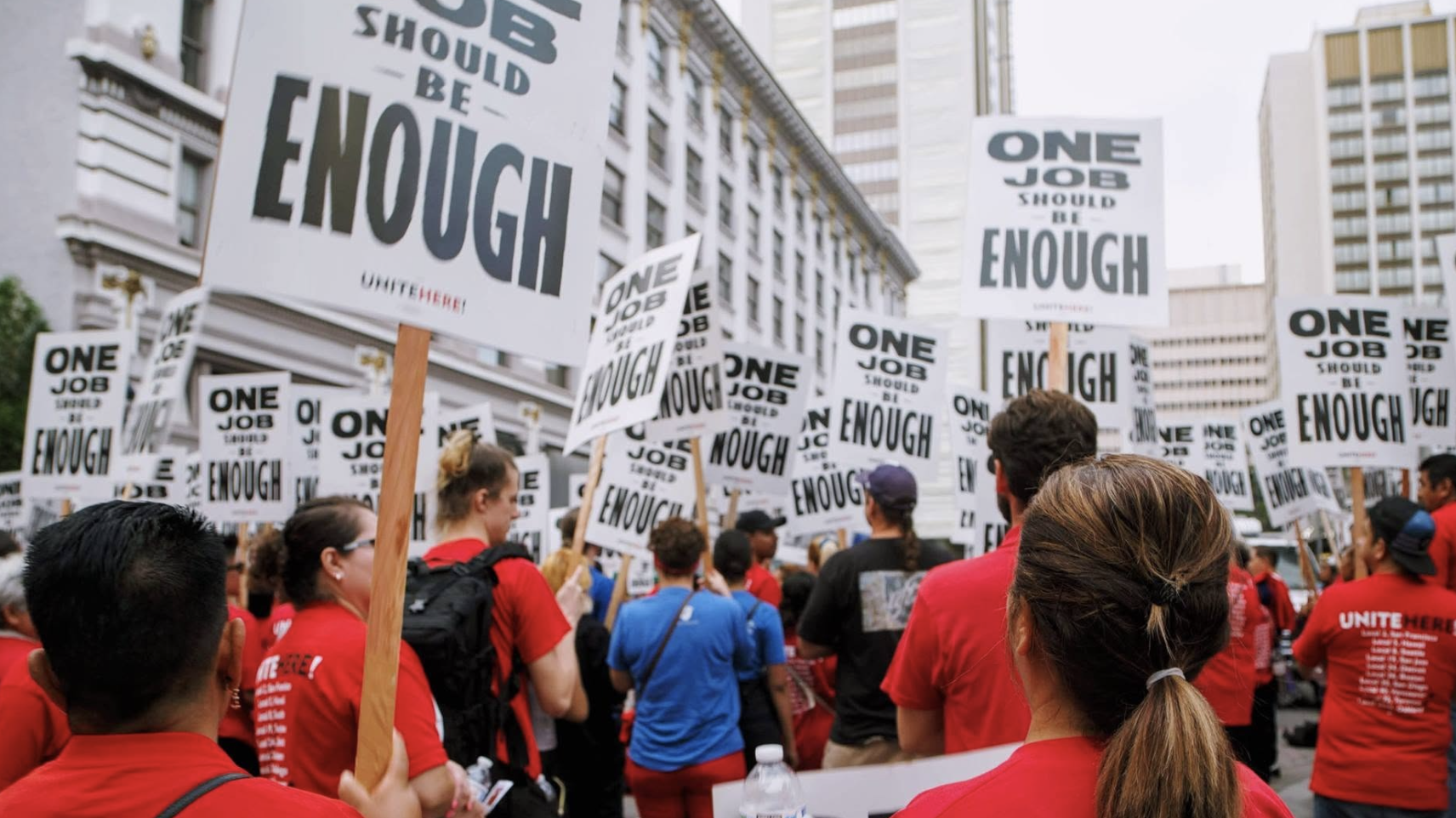
Consider this logic in the workplace. Management likes to say that nobody is forcing anyone to work there, and if we don’t like the conditions, we can quit and choose another job. Formally and legally, this is true. We can hang up our aprons and walk out the door. Yet we need wages to pay for rent and groceries, and the next manager at the next job will say the same thing. This social arrangement is voluntary in the abstract, sure, yet in reality it is coercive. When our choice is between a bad job and no job at all, the “freedom” being offered is hollow. It simply is the freedom for capital to exploit and profit above all else.

In the U.S., bourgeois morality has also carried a racist and sexist component. It was used to justify slavery, segregation, lynching, and oppression. It cast people of color as outside the bounds of full humanity and convinced sections of white workers to see Black workers as competitors rather than allies. It confined women to the home, denied them the vote, and paid them far less when they entered the workforce, all while moralizing about their “natural” place in the family and society. These ideas did not arise by accident, but rather served a purpose: to divide the working class, weaken its capacity to fight for its own interests, and allow the ruling class to super-exploit entire segments of the population for maximum profits.
For Marxists, freedom and equality are only made real when basic material needs are guaranteed and where there is no longer exploitation and oppression of man by man. Only these conditions will allow for free development of the individual. And because the working class is the vast majority of humanity, and because society is built on labor, when workers fight for their class interests and freedom, they are fighting for the emancipation of all humanity.
A living morality
What then, constitutes morality for Marxists? What is considered “good” and ethical? I propose this: There are real moral universals, but they are historical products and not eternal truths. They arise from a particular standpoint — the working class — and they have universal scope because of what the working class is and what its emancipation entails.
Because society is divided into classes, any morality by definition has a class character. What is “good” for the capitalist class — profit, accumulation, rent, monopoly power, etc — is not “good” for workers. But the working class can only free itself by “abolishing class society as such.” In fact, Marx and Engels wrote in The Communist Manifesto that the free development of each is the condition for the free development of all.
What’s “good for the working class” does not mean “whatever any worker happens to want right now.” It means that “what is good” serves the historical interests of the working class in ending exploitation and oppression. Marx and Engels made this distinction in The Holy Family: it is not a question of what this or that worker, or even the whole working class, regards at the moment as its aim, but of what the working class is, and what, in accordance with its being, it will historically be compelled to do.
Marxist ethics is therefore class-partisan in standpoint but universal in its aim. It “takes the side” of the working class, not because exploitation is “unfair” in the abstract, but because the emancipation of the working class is the condition for universal human freedom.
Marxism does not reject morality, far from it, but it does reject the empty moralizing of the capitalist class which claims universality. Instead, Marxist ethics offers us a critical morality, and indeed a partisan one at that. It does not accept the moral claims of the ruling class as neutral. It asks what interests they serve and what conditions produced them. Ethics here is not passive, but rather an active call to understand the world and to change it.
Marxist morality in practice
Here Lenin’s concept of universal interests takes on importance. “The interests of social development rank higher than the interests of the proletariat,” he wrote in A Draft of Our Party Programme, “the interests of the whole working-class movement in its entirety rank higher than the interests of a separate stratum of workers or separate moments of the movement.”
Consider nuclear weapons. They are an integral part of the imperialist system and not an “immoral” device of an otherwise moral system. Nuclear war cannot be justified under any circumstances. No emancipatory end can be served by the destruction of humanity, first of all, and constructing socialism under conditions in which the material basis for it is destroyed is politically indefensible.

Marxist ethics also distinguishes between wars of national liberation and self-defense from wars of imperialist conquest and for the redivision of the world. The war on Palestine, the aggression against Iran, and the broader militarization of the world are not contests over “freedom” and “democracy”; they are struggles over markets, natural resources, and strategic dominance. They set workers of one country against workers of another, while the ruling class and military-industrial complex profit massively and reaction is strengthened.
On the other hand, the Vietnamese war against U.S. aggression and World War II against fascism are considered “just wars” of survival against inhuman barbarism and occupation. Communists supported them because defeating fascism, defending working class gains, and driving out occupying powers advanced the interests of not only the working class, but indeed advanced the interests of social development as a whole.
What about religion?
Religion is a moral force that Marxism and the communist movement cannot ignore. Marx’s famous description of religion as “the opium of the people” is often quoted without its proper context. What Marx actually wrote was that religious suffering is “at one and the same time the expression of real suffering and a protest against real suffering. Religion is the sigh of the oppressed creature, the heart of a heartless world, and the soul of soulless conditions. It is the opium of the people.”
Yes, it is true that religion can be used to pacify and to rile up reaction, but it can also express protest against an inhuman system.
Many working-class people continue to draw their moral commitments from religion. If the workers’ movement simply dismisses religion as “false consciousness” it will fail to connect with the actual lives of many working people. Our task, I think, is to engage with it critically and concretely; to recognize the progressive content in religion, such as its commitments to justice, dignity, and solidarity which can be tools in the struggle for socialism.
We all long to be free
So what does it mean to live a moral life under capitalism? At its core, I think it means grounding our morality in the struggle for real emancipation — socialism. It means recognizing that some things are incompatible with human freedom, not because they violate abstract rules, but because they are structurally opposed to the free development of all. And of course it entails actively building a working class movement that can fight in its own interests, on its own terms.
Marxist ethics is ultimately the promotion of true freedom. Not the abstract “freedom” of the ruling class, which is hollow for those who cannot exercise it, but the real, liberating freedom of the working masses. It is the freedom that comes when the right to a dignified life and development is a lived everyday reality for all of humanity.
The opinions of the author do not necessarily reflect the positions of the CPUSA.
Images: UNITE HERE Local 3o on the picket line. Unite HERE Facebook; Fox News Channel. Steve Rhodes on Flickr; Car Service workers. Wikimedia Commons; A Nuclear Free World. Campaign for Nuclear Disarmament.
Author

-
Cameron Harrison is a trade union activist and organizer for the CPUSA Labor Commission.
 Join Now