

This is the first article in a planned series called We The People: 250+ Years of Working Class USA.
We do not arrive at our political understanding because we were raised in the perfect household. We have a journey behind us, and somewhere along that path, we asked questions. For me, questioning isn’t just a habit, it’s my greatest strength. “What is written on his shirt?” I asked myself, “I’ve never seen glasses like those.” I would think, “Hi, my name is John, what’s yours?” These moments of curiosity crack open opportunities that a speech never would. It can feel embarrassing, but embarrassment is something we underexplore. Use it to create the chance to make genuine connections.
Asking questions is only half the challenge. Once you ask, you have to listen. Humans are very good at sensing intentions; we can rarely slip past it, so don’t try. Be genuinely curious about the person in front of you. Listen to their answers. If you want to teach them, persuade them, or simply be heard by them, you first need to know where they’re starting.
Reading the room (and the gas station)
Public interaction happens within a context. Are you at a gas station? A bus stop? A community meeting? Understand what the other person is doing, where are they going, where have they been, what are they in between. Ask yourself: how much time do they actually have? Not everyone has the bandwidth to stop for ten minutes. Just ask directly “How much time you got?” and respect the answer. It’s just a question, it shows them you are respectful of their time. Instead of using complex terms that can be difficult to understand, use plain language that simplifies your message and helps you stay accessible.
Managing cognitive load
The availability of short-form media has caused people to listen in a passive manner rather than pay attention. People are used to information that’s quick and easy to process. To use this in our work, we can use a few tools, like chunking, highlighting, and the rule of three.
Summarizing: “Bite, Snack, Meal”
Breaking information into understandable pieces. The “bite” is a starting point, the simplest takeaway. The “snack” is a relatable example or a short explanation that illustrates the point. The “meal” is a fuller explanation, offered only if you think the person is ready for it and they have the time for it. You’ll never cram a full meal down someone’s throat at a street corner, especially if they are not willing.
Verbal highlighting
This is the technique of placing emphasis on certain ideas to better convey something they should remember or pay attention to. Just as you’d bold text in an article, in speaking you would emphasize the core idea(s). Saying things like, “Here’s the thing to remember…” or “If you take one thing from this, it’s…” hints to the listener that what comes next they might want to remember.
Repetition
People retain information best when it comes in threes. Form your message around three central ideas or repeat an important point three times in different ways. This rhythm makes your words stick.
A healthcare example
Instead of ranting about the insurance industry profiteering off of a captive market, you might say:
Bite: “Healthcare should be about keeping people healthy, not about profits.”
Snack: “My friend works full-time but still can’t afford the insulin she needs, insurance denied her again. That money is going to shareholders, not patients.”
Meal: (when they want to know) “So, under a single-payer system, we’d eliminate that middleman. Everyone pays in, everyone gets care. Here’s how it’s worked in other countries…”
Verbally highlighting can come before a bite or used to summarize a meal or snack after the interaction is done: “If you remember one thing, it’s this… no one should go broke because they got sick.”
Notice how none of that required the word bourgeoisie. These techniques keep us in line with people’s learned understanding, without patronizing them. Not every recommendation will fit in each type of conversation. You shouldn’t strive to use every technique. Instead, you should strive to be understood — not just checking a list.
The shame barrier and U.S. individualism
Sometimes, people feel ashamed about not understanding politics or economics. This is by design. Power that’s complex and difficult to understand prevents us from talking about it, thus keeping us away from that power. A plain-language approach invites people in, instead of making them feel left out. It allows them to ask questions knowing you are not looking down on them for being different. The goal is never to prove you’re the smartest person in the room. It’s to connect over shared material realities, like wanting to buy a house, access to healthcare, and a good-paying job. “It’s not about being right, it’s about being able to afford a house.”
We live in an individual-focused culture. While within that culture we must use it to frame systemic problems away from the individual and towards the collective needs. Individual pride is your ally, not an obstacle. Tap into it. Frame systemic problems in terms of individual dignity: “We work big every day but get small pay. Why can’t we afford housing?” That’s a question anyone can understand, regardless of political leaning. It centers their lived experiences while pointing to a failure of the economic system.
Much like understanding and analyzing material conditions, you have to assess a person through observation which, like the scientific method, requires observation, interviewing, information collecting, and other skills.
Building our speaking
In my experience, we must be consistent with those we speak to and give them time to process. You build your own model through practice; it takes time and consistency. Start with the social circles you’re already comfortable with: your workplace, your family, your religious or community group. Use that comfort to hone the questions and skills. As you grow, and as you earn people’s trust, you will gradually educate them. Then it will spread to others. Once they teach someone else what they learned, the practice becomes unstoppable. When we genuinely meet people where they are — wherever they may be — we no longer just give speeches; we become comrades with the working class. And that shift changes everything.
The opinions of the author do not necessarily reflect the positions of the CPUSA.
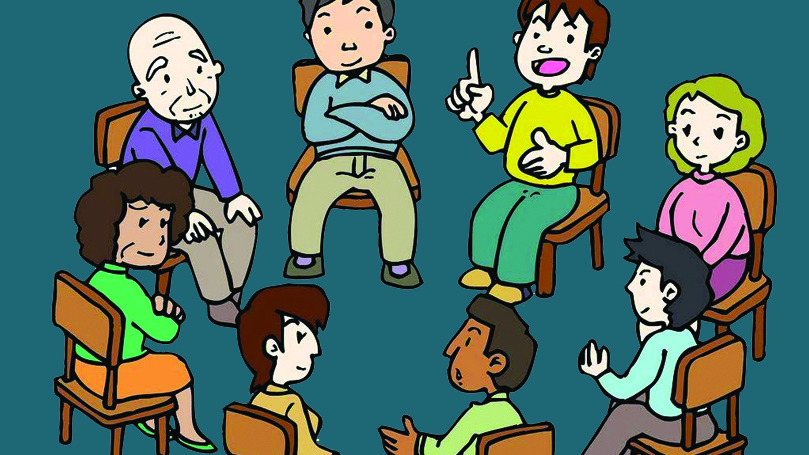
Images: People talking by Matt Moran. Facebook.

 Join Now