

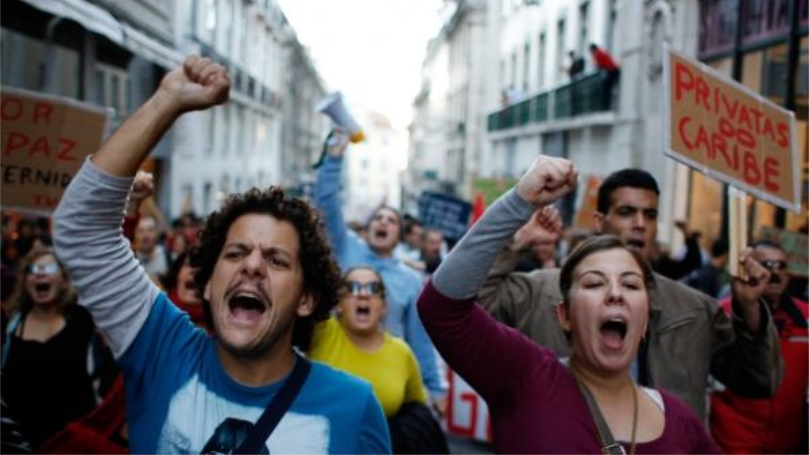
From the ports of Italy to the mines of India, from the public squares of Portugal to the picket lines re-emerging in the United States, in 2025 the international working class demonstrated a militant retort to the deepening crises of the capitalist system.
As the World Federation of Trade Unions (WFTU) declared in its militant New Year’s address, the working class entered the year armed with the “unbreakable strength of solidarity” deployed with unprecedented scale and political clarity.
The backdrop to labor’s fightback is the accelerating brutality of the capitalist system in structural decay. The capitalist state, acting as what Karl Marx identified as the executive committee of the ruling class, pursued a twin-pronged assault to shore up profits: economic war at home and imperialist war abroad.
In country after country, governments served the capitalist ruling class dutifully through aggressive privatization, labor deregulation, and the suppression of wages — even amid soaring corporate profits. Their domestic offensives against the living standards of working people are inextricably linked to escalating militarism, from the genocide in Gaza, to the growing NATO budgets and war economies, to the destabilizing threats against Venezuela and the enduring blockade of Cuba.
As the WFTU underscored, these are not separate tragedies but interconnected tools of the ruling class to secure resources, markets, and geopolitical dominance — all paid for in working-class lives and livelihoods.
Labor’s response in 2025 was a wave of mass struggles that moved beyond merely “bread and butter” battles to embrace overtly political and internationalist-oriented actions.
In Portugal, workers launched the country’s first general strike in 12 years, shutting down the country from auto plants to ports, to reject a right-wing government’s wholesale assault on workers’ living standards through the so-called “labor package reform.”
In Italy, nearly a million workers, led by the Unione Sindacale di Base (USB), staged a monumental strike not for wages, but to block arms shipments to Israel. Their declaration — “We are not complicit” — was a profound act of solidarity, with workers vowing never to let their labor serve genocide.
Most staggering was the Bharat Bandh in India, where an estimated 250 million workers joined perhaps the largest strike in history against the right-wing Modi government’s privatization frenzy.
At the same time, an important political shift occurred within some of the trade unions themselves. For example, in Greece, the class-struggle elements rooted in the Communist Party of Greece (KKE) achieved a historic electoral victory within the civil servants’ public sector union, ADEDY. Their orientation toward more militancy is as vital as the strikes themselves in order to ensure the organizations of the working class maintain their struggle-oriented roots.
For workers in the United States, 2025 was a year of stark contrasts, mirroring the international situation, between mass mobilizations and assaults on both democratic rights and living standards. Inspiring organizing drives prevailed, such as SEIU’s victory for 32,000 home healthcare workers in Michigan and the UAW’s landmark win at BlueOval SK in Kentucky. Workers at Amazon continued to organize their warehouses and gains were made among the drivers as well.
Yet, these advances were launched under severe counter-attack. Take for instance the Trump administration’s stripping of collective bargaining rights from nearly one million federal workers, the deliberate crippling of the National Labor Relations Board (NLRB), the ongoing assaults on voting rights, and the purge of over 300,000 Black women from the workforce.
The main lesson we should take from the past year is the one embodied by our international siblings: fragmented, defensive battles will fail to meet the moment. The path forward for 2026 and beyond demands a conscious, strategic turn toward struggle-oriented, mass mobilizations and working class unity.
It will require making the fight against imperialism—from Gaza to Venezuela—central to our message by understanding that war abroad fuels austerity and racism at home. It necessitates continuing to build Left-Center unity and engaging the rank-and-file to develop our unions into genuine instruments of mass struggle. It means fighting for an independent political agenda that connects the battles for democracy, jobs, peace, equality, and the planet into a working-class-led mass movement capable of fighting forward for all of humanity.
As we enter 2026, we know that the question is no longer if our working class will fight, but whether we will fight together—across borders, economic sectors, trades, race, gender, and nationality. Does our movement remain a collection of isolated parts, vulnerable to the next assault, or do we become a conscious part of the international fighting force that is continuing to rise?
Our power as a class has never lain in our complacency or falling prey to division. It lies in our greatest strength—unity—the best tool we have in this decisive new year: for the battles here and the battles to come.
The opinions of the author do not necessarily reflect the positions of the CPUSA.
Images: General strike in Portugal by libcom.org (Creative Commons).
Author

-
Cameron Harrison is a trade union activist and organizer for the CPUSA Labor Commission.
 Join Now