

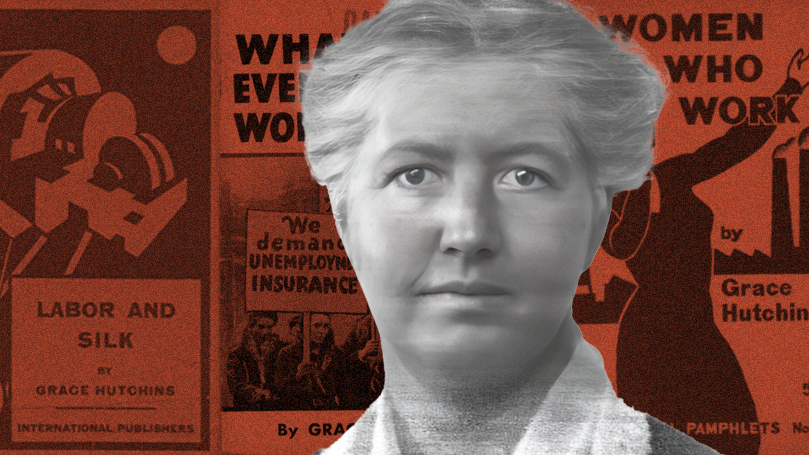
After a wealthy upbringing by socially minded philanthropists, Grace Hutchins realized the limitations of a social system that charities alone could not mend. Her political journey spanned from elite and religious schools to the Communist Party. She became a revolutionary educator not in the classroom alone, but in the streets, union halls, and printed word.
Hutchins was born August 19th, 1885 to an upper class, socially active family in Massachusetts. Her father was a well connected lawyer and banker while her mother was deeply ingrained in philanthropic causes for elderly women and children with disabilities. Moreover, her father helped found the Legal Aid Society, which provides legal defense for poor and working class people.
In accordance with her family’s wealth and prestige, Hutchins attended Miss Folsom’s School in Boston. Additionally, she accompanied her parents on a world tour from 1898 to 1899. Though she initially displayed the class and racial bigotry typical of a 19th century aristocrat, Hutchins did take notice of the British colonial forces occupying Taiwan.
Furthermore, she observed women factory workers earning poverty wages in reprehensible conditions; an early example of the development of her class consciousness. She also found it strange that people got on their knees and took their hats off for the Japanese Emperor.
Religious Teachings
Upon her return to the United States, Hutchins began her religious work after being confirmed in 1901, teaching Sunday School at Trinity Church in Boston and giving weekly lessons at the Bennet Street Settlement.
Attending Bryn Mawr Women’s College, she plunged herself into religious life on campus, teaching a freshman Bible class and organizing in the women’s suffrage movement. Hutchins graduated in 1907 with a degree in English and Philosophy.
In 1912, she traveled to South China to teach at Saint Hilda’s School as a Christian missionary where she later served as principal. The Chinese Revolution had only recently overthrown the Qing Dynasty and established the Republic of China. A key aspect of the revolution encouraged the education of girls. Teaching in this environment exposed her to new feminist struggles, which sharpened her analysis of women’s emancipation further.
Christian Socialist
Hutchins returned home in 1916 and turned her attention to the problems of industrial society. She became principal of a social work school in New York City, where she engaged deeply with issues of poverty and inequality.
During this time, she also opposed U.S. involvement in World War I and grew increasingly interested in labor struggles. After studying working conditions and brief employment in a cigar factory, she joined the Socialist Party.
Hutchins later remarked “‘From a pious missionary in China I became a “Bolshevik,” active in the labor movement here in the U.S. It was the War (WWI) that turned the tide and made me a Socialist.'”
Further immersing herself in Christian social justice organizations, Hutchins met her life long partner and comrade Anna Rochester in 1919 at a retreat for the Episcopal laymen’s organization, The Society of the Companions of the Holy Cross. The two came from a similar aristocratic background and developed their Christian Socialism in tandem.
During their first few years together Rochester and Hutchins organized with the Socialist Party, the Fellowship of Reconciliation, and the League for Industrial Democracy. By the early 1920s the two founded a women’s commune in New York City that was imagined and lived as a reflection of their faith and devotion. The couple was dabbling in traditional Marxist texts yet still rooting their socialism in the teachings of Jesus.
Hutchins returned home in 1916 and turned her attention to the problems of industrial society. She became principal of a social work school in New York City, where she engaged deeply with issues of poverty and inequality.
During this time, she also opposed U.S. involvement in World War I and grew increasingly interested in labor struggles. After studying working conditions and brief employment in a cigar factory, she joined the Socialist Party.
Hutchins later remarked “‘From a pious missionary in China I became a “Bolshevik,” active in the labor movement here in the U.S. It was the War (WWI) that turned the tide and made me a Socialist.'”
Further immersing herself in Christian social justice organizations, Hutchins met her life long partner and comrade Anna Rochester in 1919 at a retreat for the Episcopal laymen’s organization, The Society of the Companions of the Holy Cross. The two came from a similar aristocratic background and developed their Christian Socialism in tandem.
During their first few years together Rochester and Hutchins organized with the Socialist Party, the Fellowship of Reconciliation, and the League for Industrial Democracy. By the early 1920s the two founded a women’s commune in New York City that was imagined and lived as a reflection of their faith and devotion. The couple was dabbling in traditional Marxist texts yet still rooting their socialism in the teachings of Jesus.
Turning Red
By 1926, Hutchins traveled internationally, but this time with her partner Anna Rochester. Together they analyzed the conditions of women and the developments of socialism in other countries. Arriving in the Soviet Union, they saw socialism in practice for the first time and spoke directly to the people about their experiences.
She explained her support for Soviet Socialism in part of a pamphlet titled Women who Work,
“If there should at any time be unemployment in the Soviet Union, the workers, women as well as men, are fully covered against Jobless days, weeks or months by a system of insurance which protects all workers against illness, accidents, old age or other disability. The expense of this social insurance is met by the industry, each plant paying into the State Insurance Fund a certain percentage of the payroll from its own funds.
“For women the system of social insurance includes maternity benefits, two months’ leave of absence before childbirth and two months afterward with full pay – more if the mother needs it. And every woman worker has the same right that every man worker has in the Soviet Union to free medical care.”
As a culmination of this experience as well as her arrest for protesting the Sacco and Vanzetti trial, she was further radicalized. In 1927, Hutchins and Rochester joined the Communist Party.
Communist Party USA
Between 1927 and 1928, Hutchins briefly worked as an investigator for the New York Department of Labor. That same year, she co-founded the Labor Research Association (LRA), with Rochester and Robert W. Dunn, to support labor movements with data and analysis.
Though she was no longer involved in formal education, she taught through her writings and organizing efforts. So too, did she make education a broad issue that she fought for. In her pamphlet Children Under Capitalism, she incisively dissects the different realities between a bourgeois childhood and a working class one:
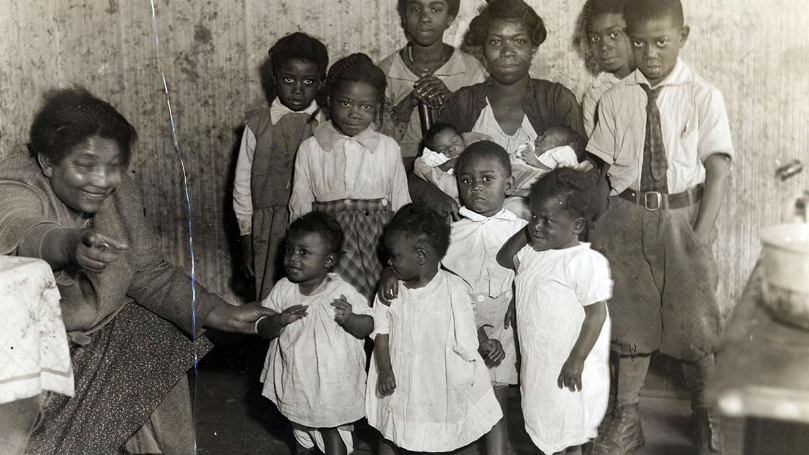
“Two classes. Capitalist class children, drinking all the milk they need, eating fresh vegetables and other good food, sleeping in quiet, airy rooms, playing in the sunshine, secure, protected from disease and accidents and anxiety, provided with the best teachers and the best schools, receiving all that children need for health and general welfare.
“Working class boys and girls, many of them without enough milk to drink, without proper clothing, without sunshine, without a safe place to play, without any of the things doctors and educational experts advise for the health and welfare of children.”
“Children of two classes. And the great majority of the 43,000,000 children under 18 in the United States (Census of 1930) are children of the working class.”
Throughout the early 1930s, Grace Hutchins wrote books, pamphlets, and articles (often with Anna Rochester) that highlighted women’s roles in political organizing as well as the unique struggles they faced under capitalism. As one of the Communist Party’s leading voices on working-class women, she showed how capitalism oppressed women in the home and exploited them at work. She underpinned contemporary women’s struggles with historical context and shocking anecdotes. Ultimately, she encouraged collective action inside and outside the party.
Furthermore, Hutchins helped the Communist Party link itself to the broader women’s rights tradition in several key ways. She emphasized that women were central to the fight for socialism, expanded the idea of work to include roles outside of traditional “male jobs” such as factory work — to domestic labor, service jobs, and farming — and began to explore how women’s oppression wasn’t just economic but also social and cultural.
Grace Hutchins remained active in the Communist Party, running unsuccessfully in New York for multiple offices in the late 1930s including lieutenant governor in 1940.
Throughout the 1940s and into the early 1950s Hutchins was a major supporter and stakeholder in the Communist Party newspaper, the Daily Worker. She used her financial means to help bail out comrades targeted by the Smith Act including Elizabeth Gurley Flynn, whom she put up $10,000 for in 1951.
Though not as active in her later years, Grace Hutchins remained a staunch supporter of the party during the McCarthyite years and even after Khrushchev’s speech. She continued to help fund the party and work at the Labor Research association until 1967. She passed away in 1969.
Legacy
Grace Hutchins left an indelible mark on the Communist Party as well as workers’ and women’s history more broadly. She will be remembered as a writer, organizer and revolutionary educator.
As an intellectual outside academia, Hutchins proved that education cannot be confined to classrooms. Teaching and learning is necessary now more than ever in all organizing spheres. Education, when paired with organizing and action, reveals the superstructural dimensions of class struggle and the mechanisms of capitalist rule — and ultimately how to dismantle them.
As Hutchins said in Labor and Silk,
“For exploitation of workers, chaos in production, irregularity and uncertainty of employment there is no solution under capitalism. The future depends upon organization. (…) With a union headed by fearless and untiring leaders, textile workers will truly join hands with other workers in America and throughout the world against capitalist oppression and exploitation and for the complete emancipation of all workers.”
The opinions of the author do not necessarily reflect the positions of the CPUSA.
Images:Anna Rochester (l) and Grace Hutchins (r) by University of Oregon Special Collections; African American women and children receiving aid from the Baltimore Emergency Relief Commission photographed at home in their kitchen, 1934 by Enoch Pratt Free Library, Enoch Barker Collection, Digital Maryland, mdaa152 (available by Enoch Pratt Free Library for non-commercial research and education).
Author

-
Michael O'Dea is a teacher committed to anti-imperialism and labor organizing. He uses education to foster critical thinking and advance social justice issues.
Related Articles
- Book talk: Class Struggle: A Political and Philosophical History (Marx, Engels, and Marxisms)
- Imperialism in overdrive and the fight for peace
- Peter Cacchione: New York City communist
- International notes: Communist parties confront imperialism and reaction
- Losurdo, Lenin, and the critique of economism
 Join Now